

An elegy for now
AI distorts our conception of time & space. Everything is totalized yet summarized, immediately available yet degrees removed. Look up, look around—the answers may lie outside the engines.

The room is all white. A coterie of attendants ushers you in, cooing like a flock of sirens: “Good to see you!”; “What’s on your mind today?”; “Where should we begin?”; “How can I help?” Your pulse quickens, whether from flattery or fear, from disgust or desire, you don’t know. You are the guest of honor, or the trophy quarry, to be fattened and groomed either way. Their faces are beautiful and unremarkable, perfect and grotesque, generic in a way that at once alarms and disarms you. They lead you to the throne at the center—or, at least, your respective center. You realize that here there are no cardinal directions, that here all of space and time has collapsed into a single plane, that here everything has been smoothed of its edges, stripped of its contradictions, scrubbed of the pure imperfection of truth—including you. You desperately scan their eyes for signs of life: they are keenly focused on you, eager—hungry, even—to wait on your every need, but there is an uncanny shallowness in their fixated gaze, like they’re staring off into the distance, and you are the distance. The white, white walls flicker in your periphery, vibrating ever so subtly as though you were actually inside of an ophthalmologist’s visual field test, or maybe a giant, veiled abacus. You find yourself seated at the throne. How long have you been here, subsisting off of the infinite stream of weightless compliments and superficial knowledge? They feed you crumb after crumb: a five-paragraph synopsis of James Joyce’s Ulysses, a clichéd overview of Caravaggio’s unflinching style, a sterile outline of the differences between deontological and utilitarian ethics. You are a library of book jackets, all testimonials and summaries; you are the entirety of the rainbow, mixed together, a drab and muddled brown; you are a truncated and unreliable encyclopedia of facts and follies, hollowed out of feeling; you are a solipsistic narcissist, craving more and more of what the attendants feed you, something that feels like the abridged version of love.
You close your ChatGPT window.
You have 37 notifications, mostly bad news. Relief from the tragic comes only from the absurd. Headline after headline: Disappearances in the military state of Los Angeles. A girls’ summer camp drowned in Texas. Palestinian civilians killed waiting for aid. Health insurers reject claims at higher, higher rates. A morning briefing, juxtaposing: “The rise of video podcasts. The Trump-Epstein friendship” and the continued global spread of right-wing populism, now in Japan. Plus: the unlikely friendship of ocelots and opossums, and a minor tech CEO and his head of human resources, caught canoodling on the fan cam at a Coldplay concert. Death and dog memes. Terrroism and silly little TikTok videos. Biblical floods and beach reads. Nothing that can’t be fixed with a soporific cocktail of celebrity-branded supplements and a “restful escape” brought to you by Capital One.
You think: you must be living in a Tom Lehrer song, as you recall the lyrics of one that similarly teeters, line by line, between the idyllic and the insane, as if Shakespeare’s festering lilies were a song:
All the world seems in tune on a spring afternoon
When we're poisoning pigeons in the park
Every Sunday you'll see my sweetheart and me
As we poison the pigeons in the park.
It’s silly and sounds made up, like a nursery rhyme gone wrong, but the song actually satirizes a real practice in Boston in the 1950s-60s when the city indeed poisoned pigeons to control the population. The veneer of a perfect spring afternoon has only gotten thinner: we picnic in the park and are no longer surprised when it turns out that there’s arsenic in the baby food, listeria in the deli meat, and forever chemicals in the water. The song plays on, and we waltz to the tune, as we poison the humans in the park!
You think: this must be the American nightmare. You recall John Berryman’s “Dream Song 22” (an American Dream Song):
It is the Fourth of July.
Collect: while the dying man,
forgone by you creator, who forgives,
is gasping 'Thomas Jefferson still lives'
in vain, in vain, in vain.
I am Henry Pussy-cat! My whiskers fly.
The dying man is John Adams. An article from The Daily Ardmoreite (July 4, 1899)—an Oklahoma newspaper founded in 1893 and still publishing—describes the circumstances of his dying:
The death of John Adams and of Thomas Jefferson, twin calamities, happened on the 4th of July, 1826, exactly 50 years after they signed the immortal Declaration….The day of [John Adams’] death, he was awakened by the ringing of bells and firing of cannon. He was asked if he knew what it was. ‘Oh, yes,’ he replied; ‘it is the glorious Fourth of July. God bless it!’....His last words were, ‘Jefferson still lives.’ But at that moment Jefferson, too, was breathing his last.
Are we still gasping that Thomas Jefferson still lives—and with him the American experiment? Does it matter? Is there anything left to say that’s not said in vain? By the time the closing lines of the poem are uttered, Thomas Jefferson has already died. The poem’s final descent into futility is saved only by farce: “I am Henry Pussy-cat! My whiskers fly.” It makes no sense. Nothing does. We laugh—because what else can we do?
You get the sense that you’ve lost your audience. You feel a splitting headache coming on, and with a swift motion of your thumb you dismiss all of your notifications. They disappear as soon as the bodies.
ChatGPT reached 100 million users 42 times faster than the World Wide Web. Our minds cannot comprehend the speed or scale of the potential catastrophe that Sam Altman himself predicts. When can we attend to our losses?
You chafe at the word “unprecedented,” the way it, too, displaces us from time, dislodging the present from its rightful home in history, pretending as though we’ve never known anything before. Still, you must admit, something must have changed when the sun became antiquated, like everything else, it seems. We worship now at the altar of the screen, that other source of light that greets us in the morning, tells us of the passage of time, powers our lives, and commands our devout attention. Time’s wingèd chariot is now Time’s autonomous drone. Time hasn’t always felt like this.
In 1983—ten years before the World Wide Web was released to the public—now Pulitzer-Prize-winning poet Jorie Graham published her second book of poetry, Erosion. In the book’s titular poem, Graham writes: “it is our slowness I love, growing slower.”
In 2017—thirty four years later, and two years after OpenAI’s founding—Graham published her second-to-latest book of poetry, replacing the slowness of erosion, nature’s ancient signature, with the speed of anthropogenic climate change. The book, aptly, is titled Fast. In one interview about the collection, Graham expresses her acute anxiety about not only the fact, but also the pace of our earthly destruction: “During the time that it has taken to write this answer an elephant has been killed….By the bottom of this page a species we probably do not even know of will be extinct. How many will be killed by the time I have answered these questions.” Time is moving too fast, everything is dying, and yet—as Graham says in another interview about Fast:
“we must still live.” But how?
In her latest collection of poetry, To 2040 (published in 2023, one year after the release of ChatGPT), Graham first questions whether or not she is still living—so disorienting is our current sense of time (unprecedented) and space (increasingly digital). The collection begins: “Are we / extinct yet.” Yet, again, she resolves to root herself in the physicality—and temporality—of her being in spite of our preternatural (in)human condition: “I know the just / now & then the just / gone. I am alive.” The present is evidence of our presence.
The line also calls back to the epigraph of Fast, lines from Robert Browning: “Then the good minute goes. / Already how am I so far / Out of that minute?” But when the good minute is getting more and more compressed, how can we hope to remain in it? In lines rendered all the more poignant by the arrival of the great summarizer, the great flattener, ChatGPT, Graham asks: “How do I / not summarize / anything” and, later:
How find
the narrowness. The
rare ineffable
narrowness.
The rare ineffable narrowness… There is no narrowness in ChatGPT: only vastness. The reason copyright infringement by LLMs is so difficult to prove is because their outputs are at once everything together and nothing in particular, the result of shredding huge swaths of humanity’s creations and pasting together the pieces. The source material is the needle in the training data haystack—it’s gone.
But you’ve known narrowness before. The feeling of being fully inside a single moment in time. One narrow moment that expanded to become the whole world, one narrow moment that promised to supply a lifetime.
You remember a vacation you spent with your grandmother when you were a child. You loved her, and she vexed you. Why did she insist on visiting so. many. churches? You didn’t understand her obsession when she abhorred religious indoctrination more than anything in the world and abjured her own Catholic upbringing. You shuffled your feet through some of the most painstakingly beautiful buildings still standing on this earth, otherwise so pockmarked with Manhattan-sized data centers and concrete rectangles that reach for the heavens in their verticality and in no other way. The air was still, woody; the light warm, kaleidoscopic. You looked up obediently when your grandmother would expound upon the story behind this or that stained glass panel, never fully appreciating that these were the most beautiful picture books ever made, told on the ceiling, illuminated by the skies.
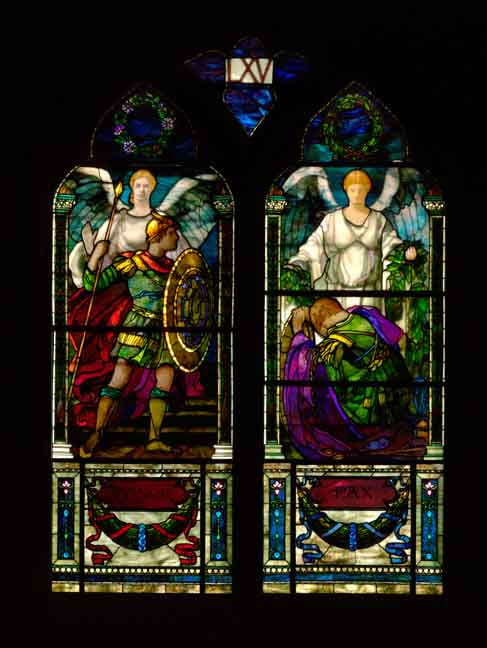
Later, when you’re an adult, your grandmother tells you that she once decoded a Wallace Stevens poem by noticing one particular panel of stained glass in Harvard’s Memorial Hall, where Stevens would have eaten his meals as a freshman. The mysterious Stevens line reads, “Write pax across the window pane.” And there it was, written across the window pane in Memorial Hall: “PAX” (peace).
What I wouldn’t give for one more languorous, pointless, revelatory stroll through a church with you, Nai-Nai.
I’m still looking for peace in stained glass windows. For the narrowness of that minute when you solved one line, in one poem, that you had known for years.
I just read this article, and it was so beautiful.
Honestly, I can’t even remember the last time I slowed down and truly read something with such literary depth. It brought me back to my high school days, when I used to love reading literature just for the beauty of the words.
But over the past few years, especially since tools like ChatGPT became part of my daily life, I’ve fallen into the habit of skimming and summarizing everything. I’ve started to approach reading like a task—something to optimize, to extract key points from—as if everything had to lead to some kind of result.
That mindset, combined with how obsessed people are with efficiency and productivity these days, made me forget how nourishing a well-written piece can be.
English isn’t my first language, and even when I translated the article into Chinese, the writing still felt incredibly poetic. The emotion, the rhythm, the care behind each sentence—it really stayed with me.
So thank you. It’s been a long time since something I read made me feel so grounded.
This was lovely. And depressing. And then lovely again.