


I turned 20 years old in one of Boston’s coldest winters. It was my first month back at school after spending winter break at home in Los Angeles, recovering from a tonsillectomy. I had gotten mono in the fall and suffered the entire semester with tonsils as white and pitted and round as golf balls, hopped up on a cocktail of antibiotics, prednisone, and codeine. Back in LA, I drank fruit smoothies and lay out in the sun. And by the end of it, I was better.
Things I started to notice at home after everything would turn grey for six months in Boston.
The second boy I ever said “I love you” to had broken up with me for the first time that winter break (he would do so two more times before finally letting me go), so in the spring I was never closer to my girl friends, who didn’t like him. We dressed up, we went out, we danced, we got hurt, we ate too much, and then too little, we were, mostly, indestructible.
More importantly, I had fallen in love with poetry—not writing it, but rather analyzing it—and in the last two years of college I did all that I could to take poetry courses and not much else and still graduate. There was too much to say about words and lines!


In my junior year, in a tutorial meant to prepare English majors to write their senior theses, I wrote a 28-page paper on Elizabeth Bishop’s animal poems. It was called “Elizabeth and Friends” and began:
“I am so eager to go to the circus,” wrote Elizabeth Bishop to her friend Donald Stanford on April 5, 1934, right after drawing him a picture of how birds warm themselves in chimney pots at Vassar College: three black birds perched on one merry-go-round-shaped chimney pot, two “with their tails inside” on either side of one “switch[ed] around” with his head poking in. Vertical squiggly lines rise from the chimney pot and the birds to the sky—perhaps they are heat waves from the pot, or chirps from the birds.
And in my senior year—after many nights that crept into mornings spent clandestinely camping out in the law school library past closing until I would finally half-skip, half-dance back to my dorm at 5AM, high off of a new discovery, or a damned good sentence—I completed my thesis, a 65-page review of Seamus Heaney’s entire poetic career. It was called “How Airy and How Earthed: Seamus Heaney’s Dig to the Sky at the Bottom of It All,” and it is stored in the university’s archives.
It, too, began whimsically, with an epigraph of a nursery rhyme that Heaney kept with him through adulthood and that encapsulates his dual airiness and earthliness as a poet, concerned with the cosmos of the universe as much as the bogs of Ireland:
One fine October’s morning September last July / The moon lay thick upon the ground, the mud shone in the sky.
I turned in my thesis on March 9, 2020.
The next morning, the university announced that all students needed to vacate their dorms and return home within the next five days.
That’s when time started to slide.
A couple of quarantined months later, I graduated from college from bed via YouTube live-stream. I was newly boyfriendless (yes, this was the third and final time that that same boy broke up with me), and soon to be jobless. The job I had lined up—a position in the mailroom of Creative Artists Agency, where I hoped to read things and get paid (albeit for just north of minimum wage)—was indefinitely postponed because of the pandemic, and in time would be eliminated. George Floyd had been murdered a few days earlier. The COVID-19 death tolls continued to climb. The world seemed to be emptying itself, opening like a monstrous sink hole in the place of everything we ever knew.
Like everyone else, I did my best to carry on. And since no one back then could see two weeks in front of them, I leapt without looking. At the advice of an older friend—a data scientist in tech and fellow humanist in college, a musician—I researched what product managers did. It was a job I had never heard of in college, happily sequestered in my stacks of poetry books, but after many cold emails and coffee chats, it seemed like one that might actually suit me, requiring a mind that is at once analytical and creative, the ability to communicate with and guide people, and, perhaps most of all, empathy. (Yes, empathy is actually a quality for which PMs are explicitly valued—it shows up in many rubrics for career progression! Communication, too—in my first year of work I was nominated for a company-wide storytelling award.) And so I began a new and unanticipated career as a PM in tech and was fortunate to work at companies that valued my unique way of breaking down systems and whose missions I supported: financial inclusion, renewable energy.
I also fell in love, in a big way, with a boy I met on the internet and drove six hours to meet for the first time and have been with ever since. I worked remotely and spent a lot of time driving through the Sierras with my dog as my boyfriend briefly settled in Reno, Nevada, a city for which I developed an unexpected fondness. It was cold, but it was desert-cold. The Sierras turn purple just like the San Gabriel Mountains do. I was a poetry critic turned product manager; he was a ballet dancer turned software engineer. Together, we drifted across the west like tumbleweed, our stems displaced but our branches entangled, a rootless home that was nevertheless still home.


I marked the passage of time with the mile markers. Still, the highway hypnosis set in. Before I knew it, my early twenties had flowed imperceptibly into my late ones.
It was desire that finally sharpened my perception of time—ultimately my awareness of being alive. Many days of the week, many weeks of the year, my work offered me morsels of purpose: I got a thrill out of poring over customer research with a critical lens, identifying themes across disparate threads and reading between the lines for the needs behind the problems; I took pleasure in learning the new languages, of the engineers, of the designers, of the lawyers; I relished collaborating on designs in Figma until they looked just right to my aesthetically obsessed eye; I found gratification in building features that made even the slightest difference in the world—tools to help people living paycheck to paycheck get into a better financial position, tools to help solar businesses sell and install more systems. Work-life balance still existed in tech, and I made time to read and try new things and be in nature outside of work.
But, having watched my mother, who dreamed of becoming a poet and became a lawyer instead, never fully recover from her own pragmatism, I was keenly aware of how malnourishment of the soul manifested. Over the years, my hunger for more humanism and creativity in my work had intensified from a subtle pang to an intolerable vacancy. My body had begun to consume itself as I ground my teeth at night, gnawing at nothing but my own enamel. I knew that the moment I stopped hungering would be the moment I started to die.
So, logically, I went to business school. (This is a joke.)
But in truth the decision was earnest: as I entered my late twenties, after nearly two decades spent sprinting towards finish lines, I wanted to afford myself two years dedicated to being unfinished; and many mentors of mine, including ones in the arts, believed that business was the widest keyboard one could play on and felt sure that I could find my tune.
It turns out, business school is a very revelatory and very strange place to be if you’re a humanist at large trying to navigate your 20s in the AI era.
Very revelatory, because even if you go to business school only to return to art and start a newsletter with your trader-by-day-poet-by-night best friend you meet there, maybe that was the whole point. Birds’ homing instincts evolved from the necessity of departure: birds know where home is because they’ve always had to leave it. It might be similar for humans. As T.S. Eliot wrote,
We shall not cease from exploration
And the end of all our exploring
Will be to arrive where we started
And know the place for the first time.
And very strange, because all sorts of other forces can interfere with your magnetic field. Like the current pulling you towards the conventional post-business-school paths. Or the draw of funding, and the idea of founding a venture-backable business. Or the all-consuming noise about AI, and posts like “YC on how to spend your 20s in the AI era.”
So, in honor of our waning twenties in the AI era, we’ve redlined the compilation of YC’s advice that’s been floating around with some notes of our own (bolded = our thoughts).
YC’s guide on how to spend your 20s in the AI era, edited by us
Core takeaways
Best time in history to start a company due to AI
It’s also one of the most competitive times in history to start a company, and it’s tempting to build for the wrong reasons. Never before has it been easier to get from nothing to a working prototype, which means that the barrier to entry is lower, but the bar for quality is higher. Your 20s are also the best time for reflecting on why you would found a company and what you would want to spend the next 10 years building. If you’re not starting a company out of deep personal conviction—a clarion call that will eat up your nights and weekends—you’re feeding someone else’s ambition.
Real outcomes over credentials - $10M revenue beats press coverage
Empirical learning is valuable. That doesn’t mean theoretical learning is not. Don’t earn credentials for credentials’ sake. But don’t underestimate the cultivation of critical thinking skills that happens when you set aside time for education. Learning to think is important in learning to do.
Technical skills are newly valuable in AI-first world
Yes and no. Even the moguls seem to disagree on this point. Jensen Huang said, “Over the course of the last 10 years, 15 years, almost everybody who sits on the stage like this would tell you it is vital that your children learn computer science. And in fact it’s almost exactly the opposite. The technology divide has been completely closed.” Reid Hoffman, who by the way earned a master’s degree in philosophy, tweeted just a couple of months ago, “This is why I'm so outspoken about the importance of the liberal arts. They’re the training ground for understanding human complexity and having the right tools to build generational companies.” Yet the going rate for AI technical talent is, I don’t know, a bajillion dollars. So who knows.
Agency and independence are the differentiators humans retain over AI
Given that agentic AI has both of these things, we’d like to believe that humans retain many other differentiators over AI. In our last issue, we wrote about one in particular: “But our bots do not write, or speak, or mean. They mimic symbolic patterns, convert those patterns into phonemic ones, and produce something that ‘means’ something only in the sense that it has semantic meaning.” Meaning-making remains ours to do.
Speed of success has accelerated
Previous milestone was series A funding 1-2 years out of college
Current reality are [sic] $10B companies within years of graduation
New metric is 0 to $10-12M revenue in 12 months
Sure, you might be able to get to $10-12M in revenue in 12 months. But can you perfect organizational design? Talent retention? Leadership voice? Compounding brand identity? These are vital to the building and scaling of durable businesses, and they take time.
B2B SaaS now shows hypergrowth previously reserved for consumer social
The technical expertise renaissance
Pre-AI: domain expertise was king, technical skills commoditized
Post-AI: technical expertise is now the differentiator
Again, we maintain that critical thinking remains a differentiator. But we also disagree that domain expertise has been dethroned (and that it can be developed in a timeline of 1-2 months, lol). It remains important not only to have a distribution advantage, but also to build the right products. In the same talk we cited earlier, Jensen Huang continues, “The people that understand how to solve a domain problem—those people who understand domain expertise—now can utilize technology that is readily available to you.” The power of AI lies in the augmentation of domain experts who can apply it usefully and responsibly in their fields.
College students leading AI implementation over experienced professionals
Opportunity here to become a “forward deployed engineer” in any industry
If you don’t know what a “forward deployed engineer” is, you’re not alone. All it means is an engineer who works directly with customers to solve their problems. Its roots lie in the military, where forward deployment is the practice of establishing a military presence in a foreign country. We don’t know why business people are always appropriating terms of warfare. You’re a B2B SaaS engineer—not a combat soldier.
Still, the value of closing the customer empathy gap is meaningful. As technical capabilities accelerate faster than human understanding, the most valuable builders are often the translators, the ones who can transform advanced technology into practical utility. And we’re not talking only about engineers—designers, marketers, and beyond benefit from “forward-deploying” (gag, read: embedding) themselves into the environments they hope to change.
Advice for students & new grads
Go “undercover” in industries you want to disrupt
Skip the “go undercover” bit (see below for why that’s weird) and instead ask your classmates, friends, neighbors the big question: “How can I help you?” If you ask 50 people how you can help, you will surface patterns that highlight your unique insight. From there, you might find a problem worth solving that actually aligns with your expertise.
Timeline of 1-2 months to become expert in new domain
We’re sorry, but who can become an “expert” in a new domain in 1-2 months? Even considering the efficiency gains with AI, this statement is hyperbolic to the point of being irresponsible, a reflection of ego more than expertise.
Industries are receptive to “AI magic” from college students
Avoid credential maximization, focus on real outcomes, not external validation
Are market outcomes—like the $10B valuation mentioned above, let’s say, or even “YC25” on your LinkedIn—not external validation? Whether the piece of paper is a diploma or a term sheet, it’s still external validation, and you can’t achieve your way to happiness. You don’t need academic or market validation to be worthy. None of your friends love you for your “real outcomes.”
Separately, this statement coming from YC feels pretty hypocritical. YC runs four batches per year. The reality is that it relies increasingly on quick signals over deep diligence. Under this model, credential maximization is one of the most streamlined paths to success.
Beware of entrepreneurship programs that teach you to “lie” or fake progress
Learn through side projects, not just coursework
God knows we’re in the era of the side hustle. Of making sure that every second of every minute of every hour of every day of our lives is optimized, even while we’re asleep. While side projects are great, you don’t need to be productive all the time. You don’t need permission from your Oura ring to take a nap, and you don’t need your Apple watch to take a meandering bike ride through the neighborhood with a friend. You can read a book that’s not self-help or self-advancing. You can paint a bad picture. You can fall on your ass. You can drink fruit smoothies and lie out in the sun, not because you’re recovering from a tonsillectomy, but just because it makes everything better. You can do what you want to. You will be loved for it.
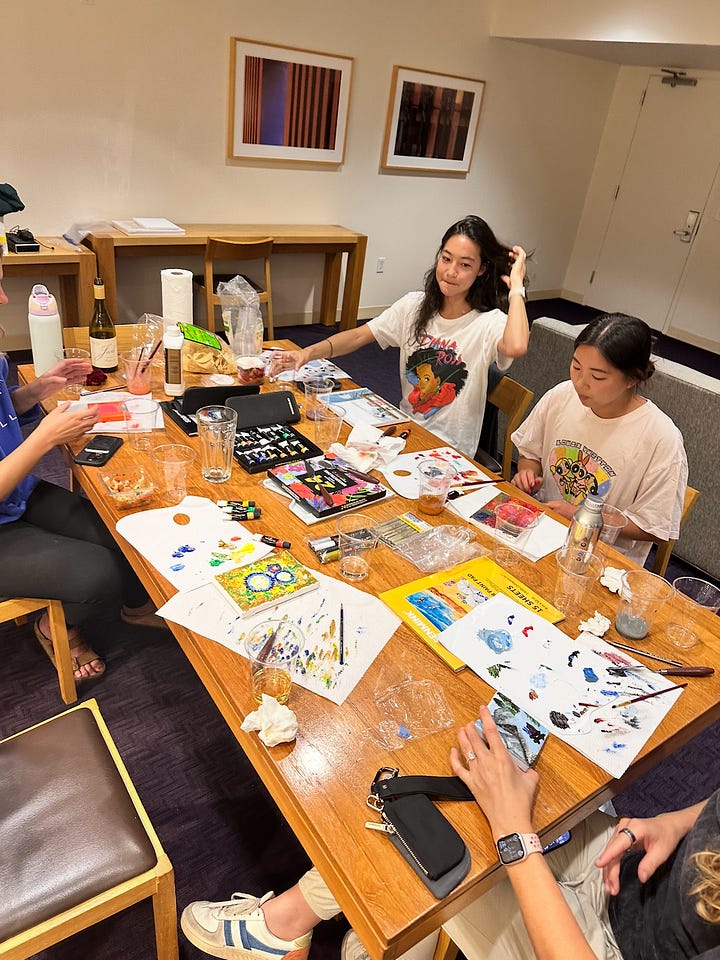
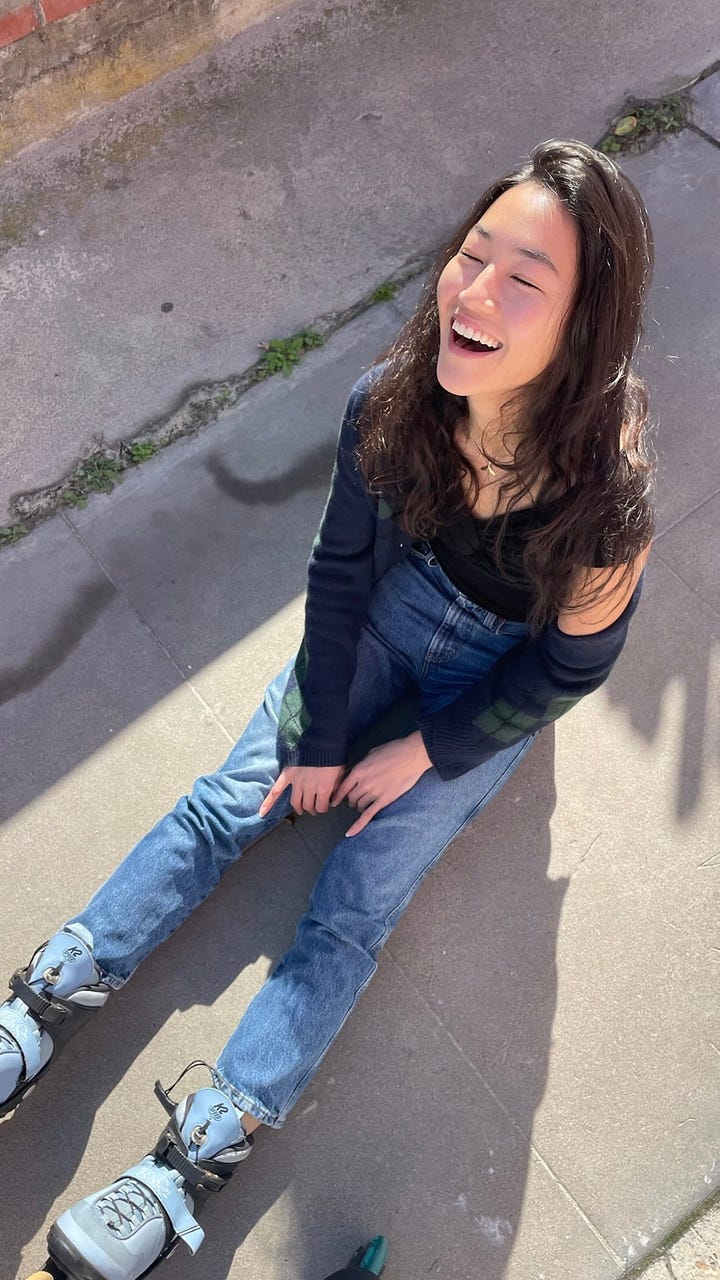
Painting bad pictures and falling on my ass in my late 20s.


Should you drop out?
Do you trust the company/founder?
Is it actually a good startup?
Are you genuinely done with college?
Additional considerations
Have you explored alternative career paths?
Are you making a fear-based or excitement-based decision?
We actually love this one. No notes except that we might not have relegated it to a sub-bullet under “Additional considerations.”
Starting a company
Make sure you have financial runway, 6-9 months minimum living expenses
Try not to do it alone, find a co-founder to work with
Yes, completely agree, AND we actually wouldn’t overthink the whole skill complementarity thing as much as the internet overhypes. Startups are emotionally destabilizing; having someone to share the weight is often the reason a company survives. So choose your partner wisely—not necessarily for how their skill-set supplements yours, but rather for how they see the world and how you treat each other.
Being niche at the start has always been the recipe to succeed
All good, but most importantly think about your why.
It is easy to feel unmoored amidst all this talk about AI. To re-ground ourselves, then, here’s our small guide on how to spend your 20s, and your 30s, not necessarily “in the AI era,” but just in the world.
Make room for exploration: Make like a bird and get lost! Then find your way back home. Trust your instincts, follow what draws you, learn to read your inner compass.
Make room for cognitive dissonance: You won’t always be consistent. Welcome disagreement, and changing your mind. As Walt Whitman wrote in “Song of Myself,” “Do I contradict myself? / Very well then I contradict myself, / (I am large, I contain multitudes.)”
Be kind to yourself (and others): Don’t beat yourself up when you encounter dead ends! It’s all information. As my grandmother always said, “Work is never lost.” And give the same grace to others—the smallest interactions (with waiters, with friends) define our character.
A good hour and a bad hour: If you’re like us and your line to your inner voice has been disconnected for…too long, try an exercise we like to call “a good hour and a bad hour.” It is what it says it is: throughout the day, or at the end of each day, keep a log of what you did, and if those hours you spent filled you with energy or drained you of it. Notice the patterns. They’re messages from you. The goal is simple: to have more good hours and fewer bad ones. Over time, hopefully, you’ll have a life that you won’t want AI to automate.
Don’t hurry so much: The meme puts it best:
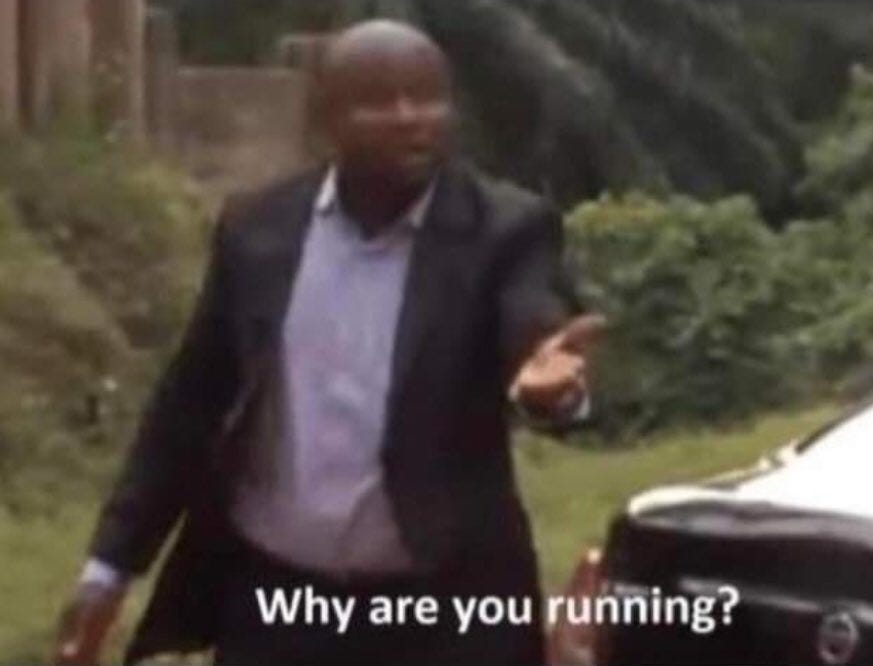
YC might tell you that you need to reach a $10B valuation before you’re 25, Forbes might show you 30 people who have achieved more than you before they’ve turned 30, and internalized pressure might convince you, especially as a woman, that you need to achieve everything you want to achieve in your career before you have children. But try not to race your way out of your 20s. Live slow and die old. Things move too fast in this world as it is.
Surround yourself with people you admire and want to learn from: People often talk about wanting to reform systems from the inside, and while we deeply admire people who dedicate their lives to changing corrupt and destructive systems, we also caution them not to let those systems change them in turn. We are mimetic creatures by nature. We learn by watching and repeating whether we like it or not. So watch what you want to model. Because as one of Nietzsche’s apothegms goes, “He who fights with monsters should be careful lest he thereby become a monster. And if thou gaze long into an abyss, the abyss will also gaze into thee.”
Surround yourself with love, including from yourself: A top school doesn’t make you lovable. A prestigious career doesn’t make you lovable. Botox doesn’t make you lovable. A curated Instagram doesn’t make you lovable. Ask your friends why they love you—I guarantee you none of them will cite any of the things you’ve chased to outrun your own insecurities (and if they do, they’re bad friends). You were born imperfect and lovable. Both God and human evolution agree on that fact.
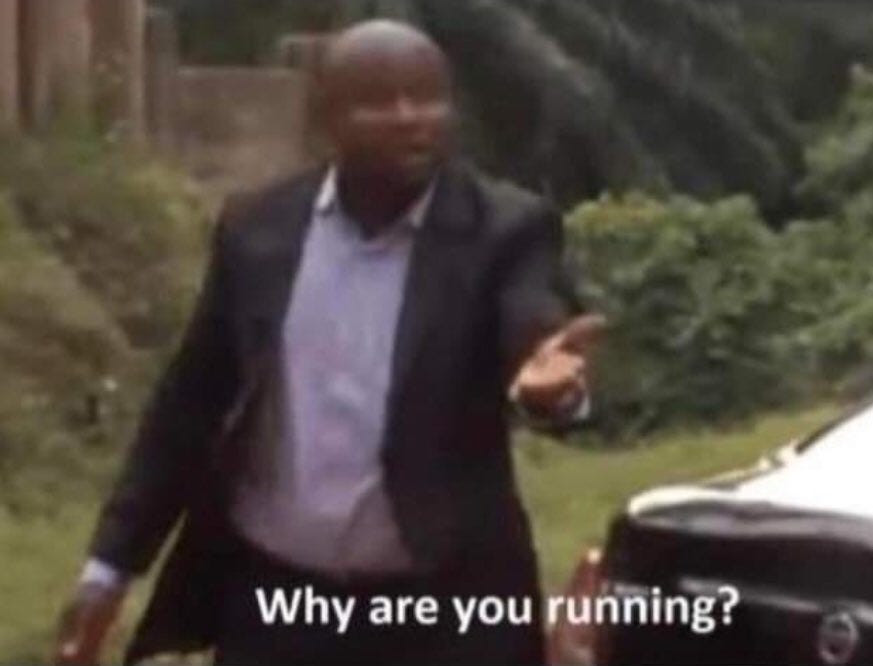
So we’ll leave you with this prompt: how would you change your life if you really believed that you didn’t need to maximize anything—be it prestige, productivity, wealth, or beauty—in order to be loved? And how can you work on giving yourself permission to make those changes?
We’re in this together. We love you.


As someone who is still in college, this was a really good read that made me rethink a lot of choices that I have been making lately. I really loved the point about making decisions from a place of excitement instead of fear!
I love all of your poetic images — the keyboard, the wiggly and intertwined lines , tumbleweeds,… I love the frank and authentic narrative voice. I love the messages and advices you are giving your audience. I also love the cute pictures, particularly the baby pictures (lol).