


There is a meme that goes like this: in the first panel of the comic-strip-style sequence, a drowning hand reaches out from the ocean with the caption “me sharing a meme about how difficult everything is rn”; in the next panel, captioned “you,” another drowning hand extends from the water; in the third panel, the two hands high-five as “you” respond “hard relate” to the meme shared; and in the final panel, captioned “us,” the two hands sink beneath the surface, drowned.
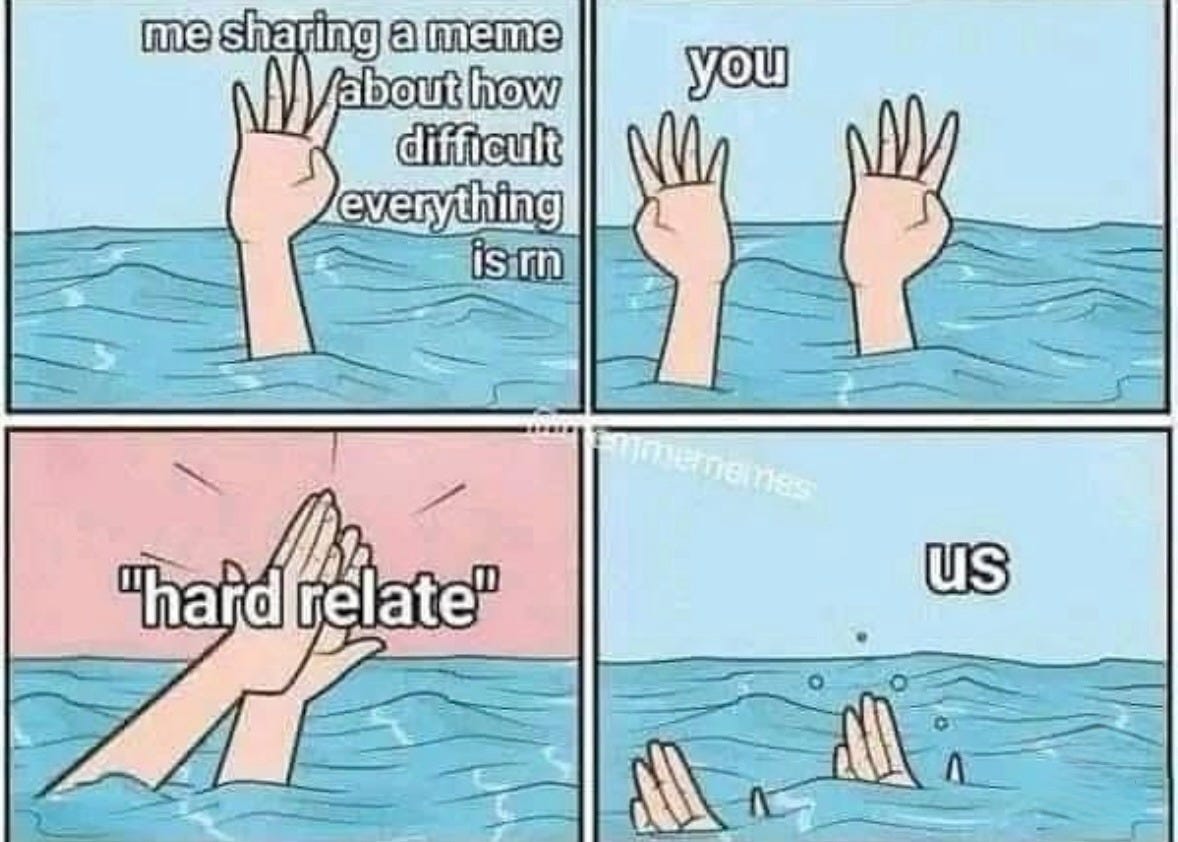
Over Instagram, one of my long-distance best friends sent me a meme “about how difficult everything is rn.” It took as its premise the adage “Life is full of ups and downs” and depicted a boy, shocked and dismayed, protesting, “You guys are having ups?”
“ME,” my friend messaged.
“LOL, been there dude,” I replied.
No more was divulged; no more was asked. I envision our hands vanishing into the water.
As much as my best friend and I know about each other, we know little more from this exchange than the TLDR: we are both getting beat up in our (late, don’t talk to us about it) twenties at a time when social media has bent the vernacular towards viral meme-speak.
Memes can be a consolation, their millions of likes a palliative reminder that someone has felt this way before. At the same time, a generic image overlaid with a slapstick joke is hardly a just rendering of our intricate emotional landscapes—the Sparknotes to our living novels. Meme-speak, I’m convinced, offers but a glint of intimacy, like a sun that doesn’t warm.
Don’t get me wrong: I love a good meme. I send memes to my favorite people daily, and my day brightens when my favorite people send me memes in return. The human act of sending memes has been analogized to the penguin practice of “pebbling,” by which certain types of penguins present each other with pebbles in an act not only of courtship, but also of homebuilding. When I send you a meme, I am presenting you with a small token of affection, one building block for our friendship fort.

And the mechanisms by which memes forge bonds are rooted in human-–not just penguin—psychology. The exchange of memes or meme-speak can be a kind of “collective effervescence,” a term coined by the French sociologist Émile Durkheim describing how shared rituals and synchronized emotional experiences foster feelings of belonging and oneness. Through a combination of sardonic humor and collective effervescence, memes help us to cope and to connect.
Memes are silly, yes, but they’re also true. My recent trail of memes depicts a satirical, simplified, yet reasonably accurate portrait of an elder Gen-Z woman, in business school despite being an English major, who craves fulfillment in her career and—in the wake of daylight savings—time in bed:


Yet still I, Céline Vendler, in all of my depths and idiosyncrasies, in all of my inflamed heartaches and invisible pains, in all of my unique branches of self-doubt and self-worth am not captured in the above tetraptych of memes.
Hundreds of thousands of people have liked—in other words resonated with—these images. Represented by these images alone, I could be one of a million people—rather than one in a million people. Memes are inherently copies, designed to be infinitely copiable by others; the word “meme” comes from the Greek “mimēma” (like “mime” and “mimetic”), meaning “that which is imitated.” Individuals, and their particular stories, are the originals.
Behind each of these images is a story of my own. Take the second image—a variation on the popular meme-format of “Born to…Forced to…”—for example. It’s immediately relatable to women in corporate settings who like to read, which is to say: a lot of women. What I feel—but don’t narrate—when I send the meme, however, is much more specific. I am one of two English majors in my business school class; rounded to the nearest whole percentage, we comprise 0% of the class. Every day on campus I feel like a scuba diver, navigating thick waters that I can’t breathe, my oxygen tank heavy, awkward, and drained by the time I get home. In my accounting class last year, I wanted to understand why we amortize intangible assets but depreciate tangible ones—not on a conceptual level, but rather on an etymological one (to “amortize” literally means to “put to death,” but to “depreciate” means only to “make less precious”—is it because intangible assets can dissipate into the ether whereas tangible assets remain in this physical world, always with some salvage value? How is this not interesting?).
My accounting professor had no answer—said that’s just the way it is.
I quote poetry in the classroom far more than one would think possible at a business school (and more, perhaps, than my classmates would prefer). None of the conventional careers in finance, big tech, and consulting appeals to me. Even one of the career advisors agreed with me that I may not be in the right place. Behind the jocular meme, then, is the acute story of my out-of-placeness, of my loneliness and of my grief, and of my relentless pursuit of air that I can finally soak up and up and up. Life is too hard to live incongruently. One must do what one was born to do; one must, so the Hopkins poem I love so much goes, “Ac[t] in God’s eye what in God’s eye he is.”
The story is not unique in theme—it can be boiled down to a meme—but don’t you know me better now that I’ve told it, in my own words?
Memes play an important role in the American zeitgeist, but when we turn to memes as our default mode of communication, we lose the rich, textural detail that makes self-disclosure so powerful. In social psychology, social penetration theory posits that intimacy is created, in part, through reciprocal, progressive self-disclosure—the operative term here being progressive. If we remain forever in the meme-plane, and never progress further into the narrative plane, we will constrain our closeness. Indeed, not all self-disclosure is created equal: what is uttered, how it is uttered, and how much is uttered all contribute to the impact of any given disclosure.
Psychological distance theory offers language as a measure of distance: we use abstract language when talking about remote ideas, and we use concrete language when talking about proximate phenomena. And yet we use generalized memes to express some of our most intimate feelings—perhaps to protect ourselves with this very distance. “It be like that sometimes” is less evocative than “I am having a difficult week and could use your support.” Similarly, “That feeling when you…” is less revealing than naming your actual feeling. Memes, much like clichés, are inherently psychologically distancing: they typically speak in the indefinite “you” (or at best the interchangeable “me”) rather than the definite “I,” and they present abstractions of the human experience rather than singular narratives.
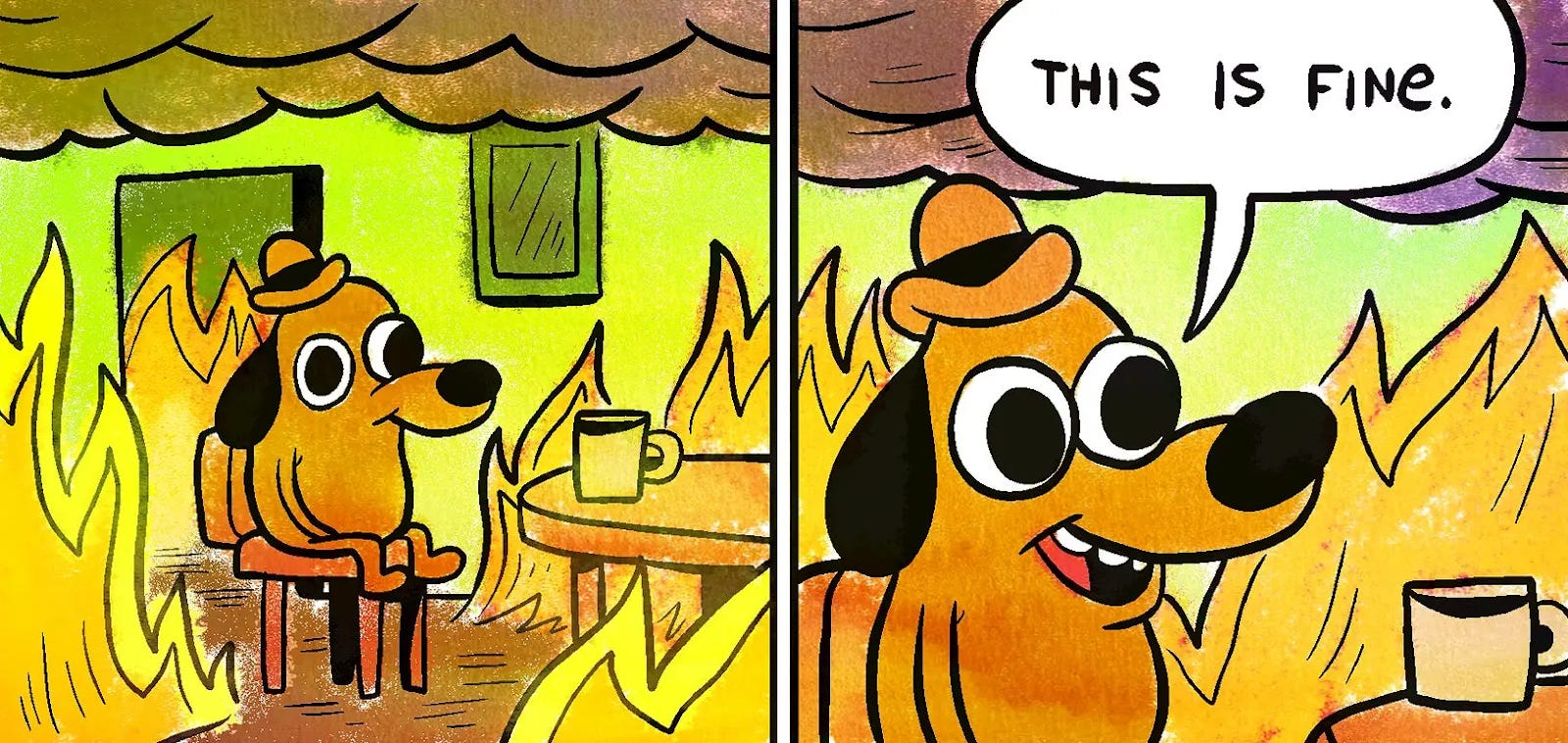
These theories are academic concepts, but they echo what intuition might tell you. You might have heard of or even tried the New York Times’s “The 36 Questions That Lead to Love,” founded in research conducted by the psychologist Arthur Aron (et al.) and practiced in organizational behavior classrooms like ours. In keeping with social penetration theory, the questions start out benign (“What would constitute a ‘perfect’ day for you?”) and progressively become more personal (“Of all the people in your family, whose death would you find most disturbing? Why?”). And to reduce psychological distance, every question requires you either to reveal a specific part of yourself or to engage with a specific part of your partner—detail is ineluctable.
Now imagine if you went through the exercise, but instead of exchanging stories, you and your partner exchanged only memes. I can’t imagine that the experiment would hold. “The 36 Questions That Lead to Brain Rot,” maybe.
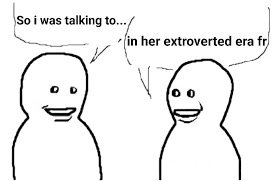
Of course, the young generations are not the first to communicate in these removed ways. The Gen-Z’s “It be like that sometimes” is the Baby Boomer’s “Life’s tough, and then you die”—one of those vaguely tautological phrases like “it is what it is” that fails to rise to a meaningful response.
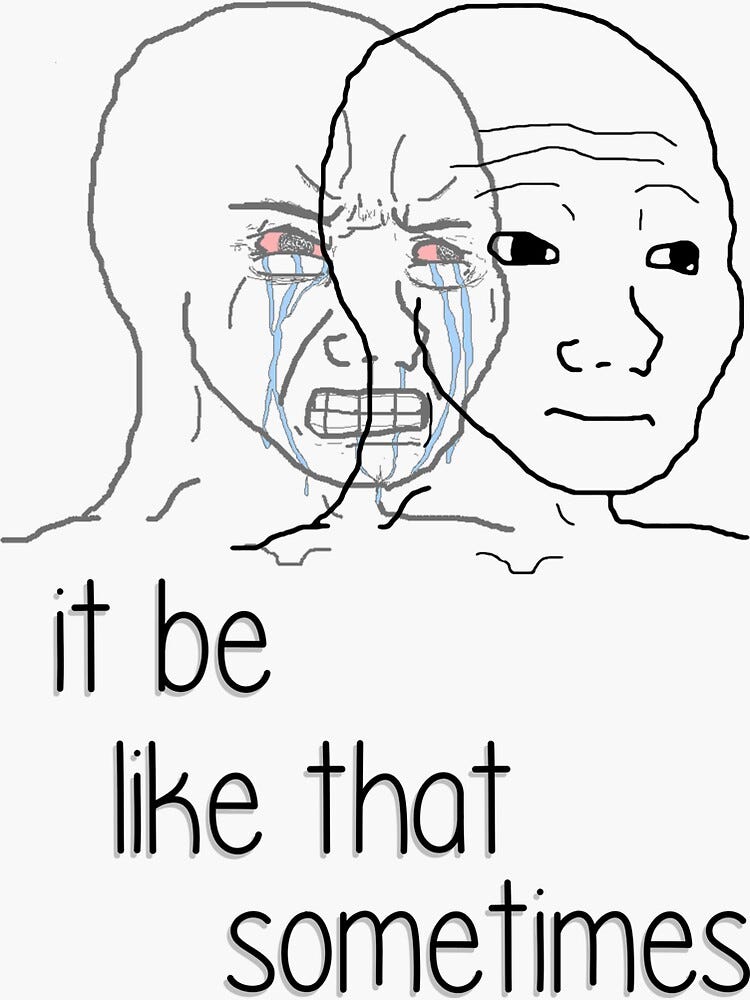
The difference, however, is that the Baby Boomer’s platitude comes in response to someone’s story, whereas the Gen-Z’s meme comes in response to…another meme. Maybe we throw in a “LOL, been there dude.” We empathize obliquely—along with the hundred thousand other people who received the same meme in their DMs—but what’s true exactly for our friend we don’t know unless we ask.
In her book Technology and the Virtues: A Philosophical Guide to a Future Worth Wanting, the philosopher Shannon Vallor distinguishes between sympathy (abstract) and empathy (concrete). She writes: “Even a stranger with whom I empathize will appear in my experience not as an abstraction, but as a concrete, nonfungible individual with specific emotional experiences.” For all of its value, then—as comic relief, as a token of friendship, as a reminder that we are not alone—meme-speak cannot be a conduit for true empathy, and resorting to it may circumscribe, rather than expand, our worlds. As Ludwig Wittgenstein, an older philosopher, asserted: “The limits of my language mean the limits of my world.”
So the next time someone asks you how you are, instead of throwing up your hands (the text version would be “¯\_(ツ)_/¯”) and deputizing a meme in your feelings’ stead, dare to allow yourself to be known—in your own words. Send the novella-length text—the kind that takes multiple scrolls before you get to the end. Leave the podcast-length voice-note—I want it to be so garrulous and multitudinous that I have to take notes. Or, as I have attempted to do here, write the long-form piece, and hope that, despite infinite distraction, or perhaps to spite it, your reader follows you to the end. As Robert Lowell wrote, “Yet why not say what happened?” I already know that it be like that sometimes. I want to know how it be for you.
The message this article conveys is just as precious as the writing that conveys it.
So much beautiful and meaningful writing. One read is not nearly enough.