


In the final week of Stanford business school, a tradition known as DisOrientation, each class nominates five faculty members to deliver what is called a Last Lecture: an hour-long hail mary to make sure, if we haven’t been paying attention these past two years, that we take away some wisdom from the GSB.
Perhaps the tradition persists because it satisfies some deep, anxious need to receive important knowledge, at the critical and very end, even if there’s no way this knowledge can be generalizable to an audience of 400, since the very nature of advice is that it arrived through a particular life, and not yours: advice etymologically means “in my view”; it is literally but one person’s perspective.
A glimpse into each lecturer’s view:
Andy Rachleff: optimize for industry first, company second, title last; become great at one thing.
Graham Weaver: fire the inner coach who has spent years tying your worth to your output; follow your energy.
Allison Kluger: lead with love and own your narrative, because if you don’t, others will fill in the gaps for you.
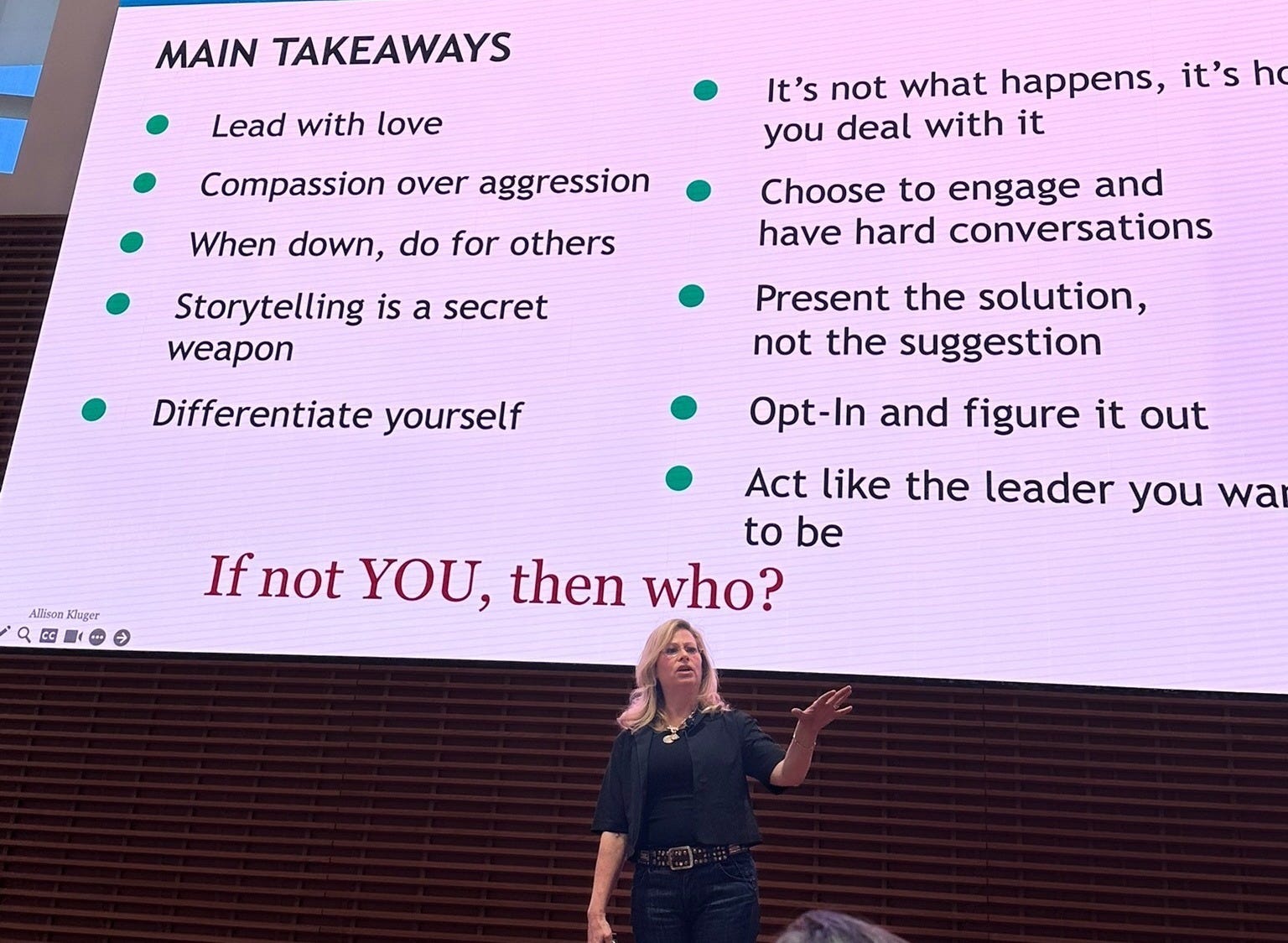
In the audience, we soon-to-be graduates wade through the brain-goo of our Last Lecturers’ sometimes philosophical, sometimes tactical, sometimes complementary, sometimes contradictory advice, while attempting—with some irony and a hell of a lot of anxiety—to apply these learnings to decisions we’ve already made. Many of us are deep in recruiting processes or already have our post-graduate plans set. Is it too late for a Last Lecture? Or too soon?
I sit in the crowd feeling, as my peers and I have been saying non-stop, “emo.” All good things must end (HAGS!), I tell myself, the girl who has happily moved apartments every year and a half for the last eight years—Chicago, New York, Los Angeles, Palo Alto (San Francisco next). Still, I resist the changing of the seasons—I will never not crave the dry heat days and the cool desert nights of a Santa Monica September, the sun-bleached palms stubbornly indifferent to leaves’ turning gradually, inevitably Autumn elsewhere.

I love change, and I feel sad about change, as I write what is necessarily becoming a valediction—if not a Last Lecture, some notes, messy and amorphous though they may be without more time and distance, on what I’m leaving with after Stanford.
What I’ve learned from business school so far (because I expect the realization of learnings to continue long after) is that career progression, and, more intimately, life progression, is a reflection of the stories we choose to tell ourselves about ourselves.
From 0 to 18—and, for some of us (shoutout myself), to 25—the story we tell ourselves is seamlessly interwoven with the story we choose to tell others about ourselves. I can sooner trace the thread from slam poetry to mortgage trading to venture capital to…marketing (?) for an interview than I can internally believe myself to be a reliable narrator. Where there is cognitive dissonance there is friction, and from that friction stems my trusty steed—call her anxiety, Imposter Syndrome, or a quarter-life existential crisis.
The friction, it turns out, is information—about the true story that underlies the one we’ve been telling. So when I think about what two years at Stanford gave me, I don’t think as much about specific classes as I do about the professors and companions who inspired me to have courage and face my particular brand of cognitive dissonance.
It’s no wonder I found my favorite professors not to be the stereotypical idols of GSB lore, but rather the female professors who have spent careers figuring out how to bring their authentic selves into rooms not necessarily designed for them—–Dannie Herzberg, Sara Rosenthal, Rachel Konrad, and Allison Kluger, among others. I learned from them as if collecting evidence, or building a vision board, or selecting a mentor without their knowledge or consent (sneaky life hack).

We wrote about the MBA as a sandbox of choice. There are, broadly, two paths through any sandbox. One is easy, at least on the surface: endless rounds of golf, drinks, trips, etc. before returning to the firm whence you came, your degree fully paid for. The other is really fucking hard. The hard path is learning—in an environment where everyone has an opinion on the best thing to do and the best way to do it (like Andy Rachleff telling us, in his Last Lecture, to join a post-product-market-fit company and consider a role in sales or finance)—how to write your story, for you and no one else.
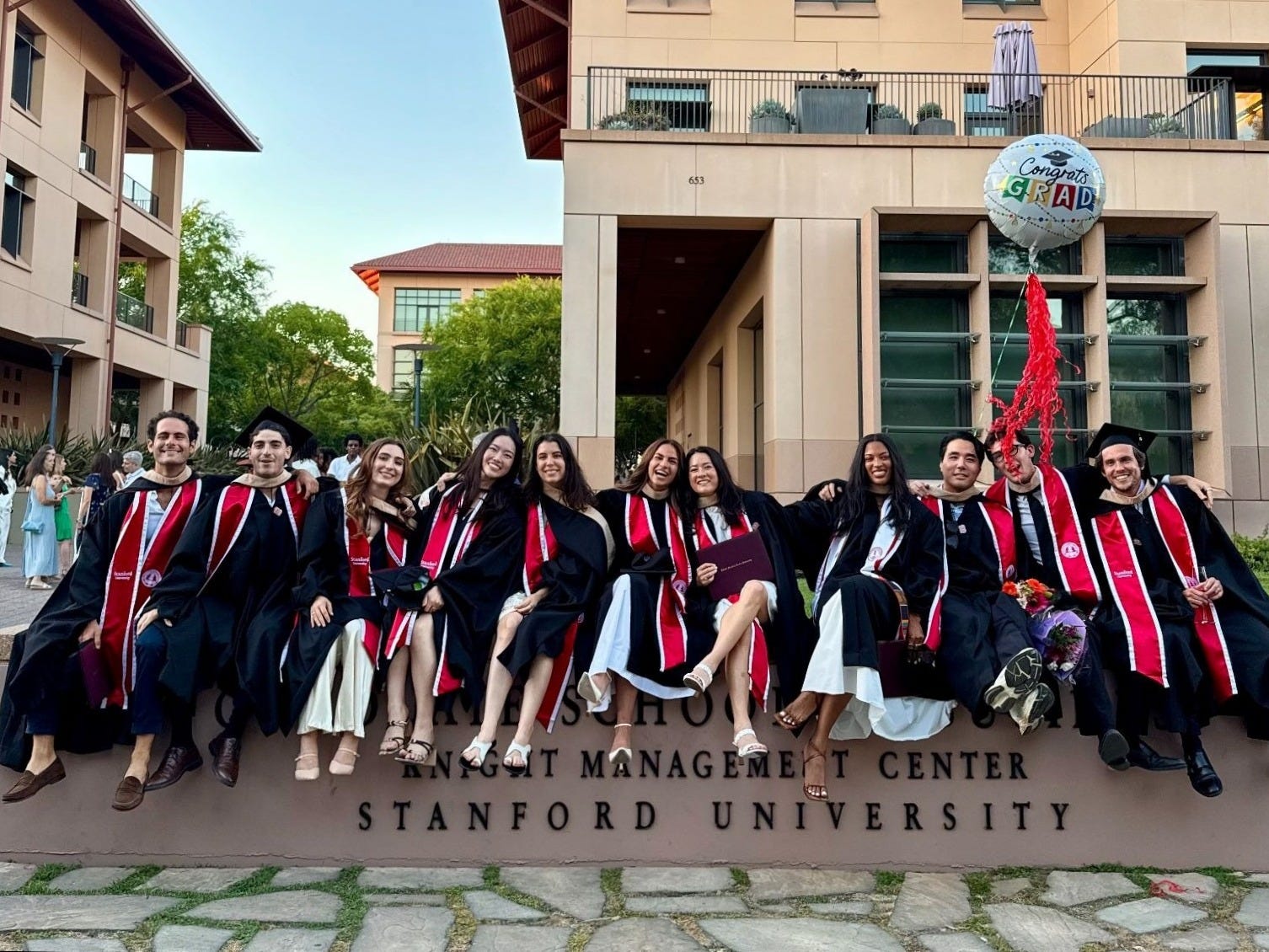
My close girlfriends and I were sitting outside our beloved Arbuckle cafeteria last week, when we plunged into a cascade of unplanned tears, waterfalling from one person to the next. In part, we were sad about an ending, but I think we were also fearful about the particular vulnerability that follows becoming closer to an honest version of yourself: you have to take her somewhere.
A friend who had spent two years recruiting hard for a finance path she’d told everyone she wanted walked away from it in the last month, when she realized she wanted to write a completely different, entrepreneurial future. She felt late—a specific feeling of regret steeped in “wasted time” and false narratives—to which we resoundingly responded: there is no timeline for growing into who you actually are. (Delusionally inspirational update: she pivoted into a managerial role at a startup after two weeks of trying.)
A friend who had built her business school identity around being a founder was now standing at the precipice of a much lonelier path than she had imagined, after her co-founder decamped to safer ground. Another founder friend was learning in real-time that rejection is not a death-knell, for either the idea or her self-worth.
And then there was me, who, for all my talk about hypothesis-testing and the optimal stopping problem1, spent a heck of a long time waiting for a clean answer or a sign from the universe, or whatever, telling myself: “Oh, I’ll hear my inner voice when it speaks up.” I’ve since learned that, while your inner voice can shake you viscerally about what’s wrong, it can’t guide you towards what’s right—not until you choose it.
You have to choose: that is listening to your inner voice—speaking into existence the answers to your questions.
We are all, in some way, standing on the precipice between the story we’ve written for others’ sake versus for our own.
Céline taught me a poem a while back (yes, taught…more on that in the next issue): Adrienne Rich descends alone into the water to find a shipwreck, equipped with a book of myths that turns out to be useless once she arrives. “[T]he wreck and not the story of the wreck,” she writes of what she’s seeking, “the thing itself and not the myth.” And later, at the very end: “a book of myths / in which / our names do not appear.”
The book of myths is the story we’ve been telling others—the one in which, notably, our true selves don’t appear. The wreck is the thing itself, you yourself; the sandbox, if you let it, is where you go down and see what’s actually there.
What I found, when I finally dove deep and peered into the wreck that is me, is the same answer I gave when I arrived.
I wrote my “what matters most to you, and why” application essay about finding my voice—about having been, at thirteen, a girl who had to stand up to read aloud in English class and whose voice shook when called upon, from the crippling terror of being perceived. I wrote about learning, slowly, to speak anyway—through writing (controlled exposure), public speaking (forced practice), and listening to the inner voice of my own desire—and about wanting to help others find their voices. I got lost, as one does, in the maze of business school—over-committing myself to clubs and finance roles that fit my rearview mirror more neatly than my dashboard; but two years later, I’ve returned to the beginning, setting out with the same goal, only now with many new tools and support systems to help me achieve it.
Part of what I love about writing Whimsy is the alien and comforting intimacy of putting something half-formed and scary out into the Internet and believing it will land somewhere. At worst, the outcome looks like witty hate-mail we get to banter with; at best, it’s a comment or a DM that a piece made someone want to write again, or that they recognized a part of themselves here.
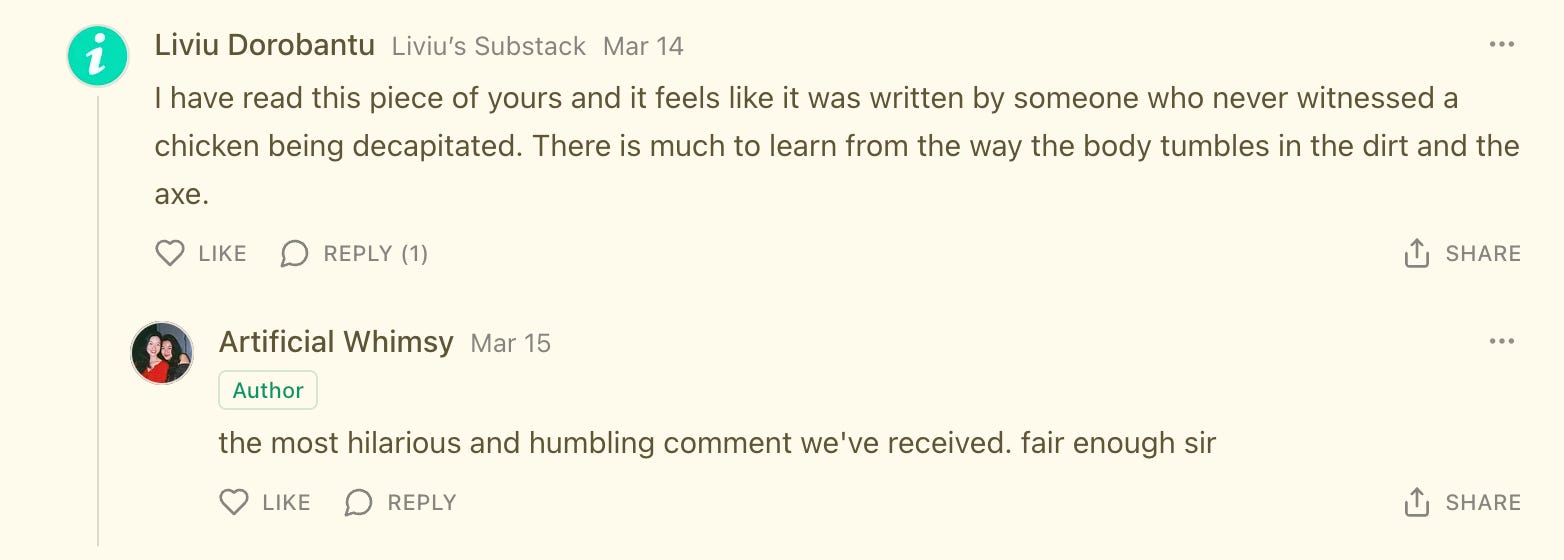
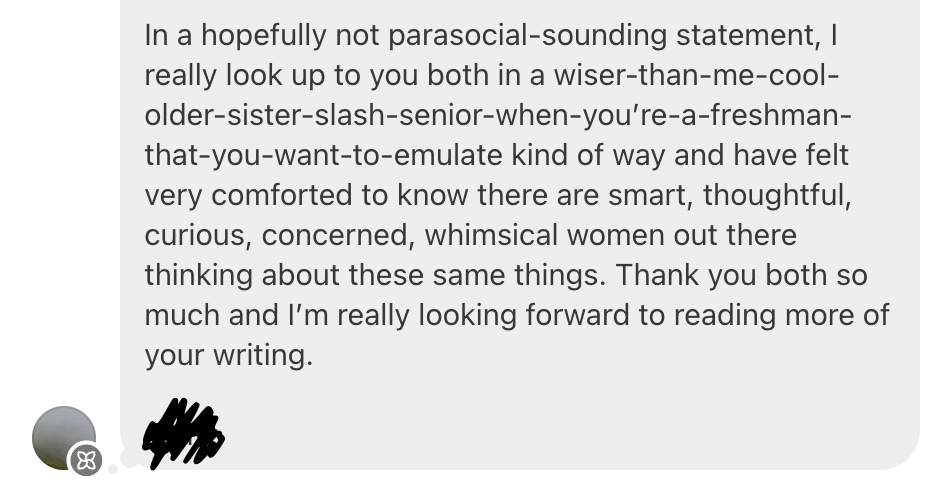
My voice is still becoming—it sometimes knows where it’s going and oftentimes doesn’t, as it didn’t when I set out to write this piece. The ultimate privilege of my time at business school has been getting to think about my story and write my story and help my best friends write their stories.
The only decently-formed thought I can pass along so far is: go towards the source of friction, resist all of the fallacies (sunk cost, loss aversion, whatever) that make you stammer, “I can’t,” and do what you need to do to make yourself fully, truly known.
What a privilege it is, to be known. For to be known is to be loved.2

weekly whimsy
what we’re reading
Danielle: Transcription by Ben Lerner, a thoughtful, brief, and highly pertinent read
Céline: Taking a Comparative Literature class this summer…first book if you want to read along with me: Buckingham Palace by Richard Rive
what we’re wearing
Céline: Nation LA Adeline Midi Dress (100% cotton and perfectly stretchy and flowy for summer)
Danielle: Hey Joanie Slope Curve and Crush Curve Ankle jeans for our short-legged queens
what we’re listening to
Danielle: FORAGER (thank you for the rec Anna K.!)
Céline: Olivia Rodrigo, “what’s wrong with me” feat. The Cure’s Robert Smith (a very cool and on-brand collab, IMO)
Written by: Danielle Zhang
Edited by: Céline Vendler
The optimal stopping problem (the secretary problem) describes the challenge of knowing when to stop searching in a situation when you can evaluate options only sequentially and can’t go back. The theoretical answer is to reject the first 37% of the field (explore), then to choose the next candidate that outperforms all previous ones (exploit). Applied to business school, one might spend the first 2 quarters exploring options in career, friendship, etc., and the final 4 quarters sticking with one’s choice of the next best option. All good in theory…
Thank you to whoever said this during DisO week (and I’m sorry for forgetting the attribution!). It was so beautifully put <3
“You your best thing, Sethe. You are.”
"Why do you go to the forest in search of the Divine? He lives in all and is yet ever distinct; he abides with you, too. As fragrance dwells in a flower, or reflection in a mirror, so the Divine dwells inside everything. Seek him therefore in your heart."
Thank you for becoming. For seeing love within to expand yourself and your universe.
https://jennumanzor.com/musings/the-self-reclaimed — I see you from across our unfamiliarity and physical distance.
Congratulations! You have touched lives (mine) by achieving :)
To be known is to be loved is from Lady Bird, an amazing fantastic movie (about Sacramento CA) Loved the reference