


Imagine this: you are 21 years old, freshly bar-legal, approaching your senior year of college (for most of you, congratulations, this is your make-believe do-over). Choose your fighter:
Get paid $250,000 by a prestigious fellowship to drop out and build (you’re not exactly sure what yet)
Do Y Combinator with a few classmates—no need to drop out, thanks to their new “Early Decision” track, borrowing the language of college and aligning itself with it
Sign a return offer with Anthropic, OpenAI, or the frontier lab of your choice for $300k+ for your first year post-grad
Go to class, learn, finish your degree with grace and uncertainty of what follows
Twenty years ago, this would have been a trick question—only Option 4 existed in earnest, and being at an institution where these options are available today held the equivalent street cred of the other three. Today all four options are theoretically attainable, funded by real and moving dollars, and actively competing for the same twenty-one-year-old’s mindshare. The Atlantic recently published “The Stanford Freshmen Who Want to Rule the World,” a piece about venture capitalists “grooming” (article’s verb choice, not mine) teenagers with pre-idea funding and yacht parties. The Atlantic excerpt is drawn from a forthcoming book by a Stanford senior, already optioned for a film. [Thank you, Blake W. for the share!]
I read the piece from the bougier side of campus. I am no freshman being courted, but as I sit at Coupa’s GSB outpost writing this, I am vicariously experiencing a familiar venture capitalist cycle through my classmates in thirty-minute intervals at a nearby table. Their loyal associate (me, in a past life) furiously scribbles notes about each classmate’s what, how, why, and most importantly, where…did you go to school? In a not-so-distant parallel life, I am the founder being interviewed, part of a broader, engineered, frictionless pipeline, designed to incentivize one thing: starting.
Starting has never been faster (thank you, AI), cheaper (thank you, VCs), or more culturally validated (thank you, Silicon Valley wealth spiral), and yet starting is still not the same thing as committing.
There are amazing ripple effects of the abundance of capital on Stanford’s campus—I’ve compared being here to Renaissance Florence, where the Medici commissions made it possible for artists to take risks that still define the celestial limits of human potential. (I chastise myself for the apologia in my comparison and wonder: what if cultural production were still the measure of a society’s competitiveness?)
Sarah Guo visited my class last week and described the ecosystem she’s helping to build: the Thiel Fellowship, Y Combinator, and her own fund’s Embed program create prestigious spaces where even failure has a buyer. This off-ramp allows people to take risks in a more structured, ironically fail-safe way. (Silicon Valley loves to credit its embrace of failure as the reason behind its innovations and successes; but if failure has an underwritten back-up plan, is it even failure anymore?) She shared that one of her favorite things about startups is that they force people to do myriad activities that have little to do with their backgrounds, and that, in successful cases, people grow enormously as leaders as a result.
Yet even the Medicis demanded commitment in exchange for patronage. Brunelleschi got money to build a specific dome—not to explore whether or not he was a “dome guy.”
I had coffee last week with a Stanford undergrad who’s deciding between a spicy return offer at Meta and starting a company with a classmate. That these two options exist in the same breath surprises me and provides further motivation to write this piece. The options comprise vastly different risk profiles that require radically different lifestyles—different relationships to identity, uncertainty, prestige, purpose, all things no twenty-one-year-old should be expected to have already figured out but nevertheless should matter in considering where to begin one’s adult life. Similarly, a friend in the business school is debating between applying to incubators with her startup idea and following her compatriots to Anthropic. To me, you have to be a fundamentally different person to choose each path, and still no one is safe—that the bubble makes one look as easy—or as interchangeable—as the other is, I think, the point.
So what is the question we are not asking ourselves?
I think…it’s what we actually care about.
A startup is much more about the commitment, the keeping it up, than the starting. As an investor, my favorite question to ask founders was: what about this problem keeps you going after it stops being fun? Or: why do you believe you’ll want to work on this for the next 10+ years?
As a person, I am trying to learn how to answer these questions myself, about my own life. I love to start things. Céline and I started Artificial Whimsy because the way people wrote about tech felt like death by a thousand LinkedIn cuts. I started this piece six times with six different theses—one of them, God help me, about the privileged paralysis of limitless optionality. My fear is that my mirror reflects someone who moves on after the quick dopamine hits of starting down a path and receiving validation, but when the going gets tough, who will not be there in the end. I worry, constantly, that I have become so delusionally good at selling my potential that I will forget how to choose to be evaluated on my own results.
I know it’s not just me. The bubble selects for people who are dazzlingly charming in thirty-minute intervals. Venture capital is a market that prices potential—a check a token of conviction that a person will convert potential energy into kinetic. But in 2005, the original information asymmetry of venture was knowing a person was sacrificing something irreplaceable, a safety net credential, by dropping out to take your fellowship money and start a company. The signal lay in the magnitude of the risk undertaken. An investor did not need a back-channel reference to know the founder was serious and committed, because the founder had torched plan B, had burned the boats. Today, dropping out is not so risky as predictable, another prestigious path to choose, next to your offer in [Big Tech, Big Three, Big Whatever].
Do not forget that the lowest-risk asset carries the lowest return.
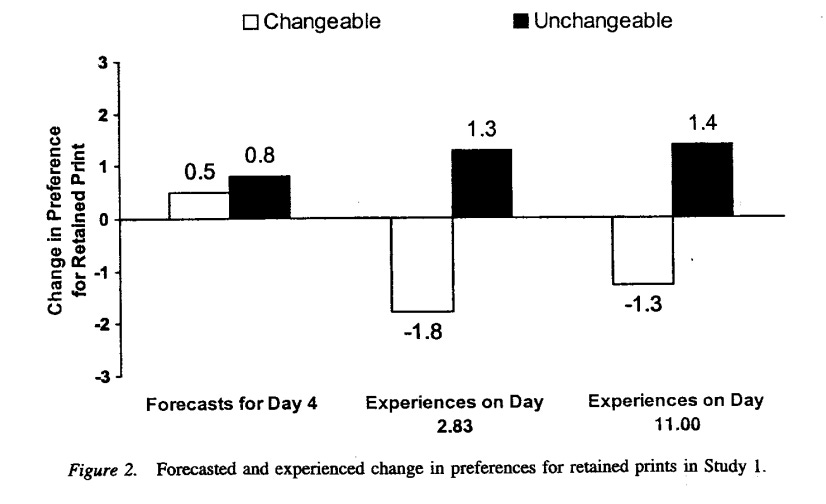
We also know the lowest-commitment decision carries the lowest satisfaction. A study from Harvard and MIT asked photography students to choose prints to keep—one group could swap their choice, while the other was stuck. Both groups initially preferred the option of being able to swap, but the group that could swap ended up liking their prints less. The researchers found that people prefer to make changeable decisions rather than unchangeable ones because they do not realize they may be more satisfied with the latter. Read that again.
The implications stretch further than startup funding or career decisions—they exist in a context where career decisions are proxies for our identities. Your job is both the answer to “what are you up to post-grad” and, whether you like it or not, the way many will define your worth.
We enjoy being many things at once. There is a tradition at the GSB called TALK, in which two students share their life stories every Wednesday with the rest of the class. If I had a penny for every TALK that mentioned duality, or existing across the many multitudes of self, I’d be fucking rich in pennies. I like the version of me that people meet and can’t place in a box—student, sister, lover of words and tiramisu, occasional beat-boxer, extremely serious sobber and psychotically happy Cheshire cat. There is real joy in plurality, and the audience’s eyes widen with awe, sometimes judgment, upon realizing that I contain more than they expected.
But I am starting to wonder whether the pleasure is in being many things or in never having to be just one. Plurality, like optionality, like the option to switch photo prints, like the $250,000 dropout fellowship…feels like freedom. Kierkegaard called anxiety “the dizziness of freedom,” the vertigo of standing above the abyss of possibility, knowing that the moment you choose, you murder every other version of yourself. Plath likened wanting to preserve optionality to never wanting to pluck figs off a tree and losing them all in the ineluctable passing of time:
One fig was a husband and a happy home and children, and another fig was a famous poet and another fig was a brilliant professor, and another fig was Ee Gee, the amazing editor, and another fig was Europe and Africa and South America….I saw myself sitting in the crotch of this fig tree, starving to death, just because I couldn’t make up my mind which of the figs I would choose. I wanted each and every one of them, but choosing one meant losing all the rest, and, as I sat there, unable to decide, the figs began to wrinkle and go black, and, one by one, they plopped to the ground at my feet.
Choose or don’t. Either way, certain options will inevitably recede.
This is why, in spite of the cost of risk having never been cheaper, the experience of taking risk has never felt worse.
What I keep forgetting (and maybe you do too) is that every time I’ve actually closed a door and forced a step forward, life got bigger, not smaller. I left trading and found a profession that paid me to meet inspiring people. I came to business school with no plan and built a community I care about more than anything on my résumé. Letting the other versions of ourselves go, in front of everyone, full fanfare, without knowing the one you choose will be enough—that is the open door I choose, and that open door tastes like freedom, the most expensive thing we can have.
weekly whimsy
What we’re watching:
Both: BEEF Season 2
What we’re using:
Danielle: the duality of Wispr Flow on solo Dish walks, and Physical Phones and
Celine: the Oxford English Dictionary. I am a purist about this and will not use any other dictionary for all of my dictionary needs (and I have many). Have I been gifted a subscription before for Christmas? Yes, yes I have.
What we’re wearing:
Celine: not Reformation—private equity has ruined it, I swear; please send recommendations my way because my whole wardrobe is propped up on this stock, and the bubble has burst!
Danielle: another plug for my Thousand Fell sustainable sneaks (size up!)
Written by: Danielle Zhang
Edited by: Céline Vendler
I fear that you killed it with this one
Banger