


In our April issue, we confronted The New York Times’s quiz, “Who’s a Better Writer: A.I. or Humans?”, and the cold, hard data that, for readers across the country, the choice between human or AI writing was, basically, a toss-up. And in our poll—“How confident are you that you can tell the difference between human and AI writing?”—the majority of you similarly chose, “Coin toss, honestly.”
In this issue, we embark upon a close reading of the human and AI passages in the NYT quiz to prove—to ourselves, to our AI overlords, to humanity—that we do believe in human writing. We do, we do.
Think about it: who benefits from the story that AI and human outputs are indistinguishable—and that, in turn, humans are replaceable by AI? Is it me, the human writing this sentence? Is it you, the human reading it? And is that story in fact true, or is there another, different truth that lies between the lines to be discovered through critical examination—through close reading?
To read and interpret, both literature and the world, more closely is to defend one’s humanity. Silicon Valley knows this fact, in its latest obsessions with human “taste” and “agency”, neither of which is possible without this capacity to assess truth and emotional resonance. So, if only to escape the permanent underclass by becoming “highly agentic people with taste,” the only kind our aforementioned overlords predict will survive the [AI]pocalypse, alongside learning to vibe-code, let’s learn how to close-read—how to spot the fake, how to seek the truth.
First question on the quiz:
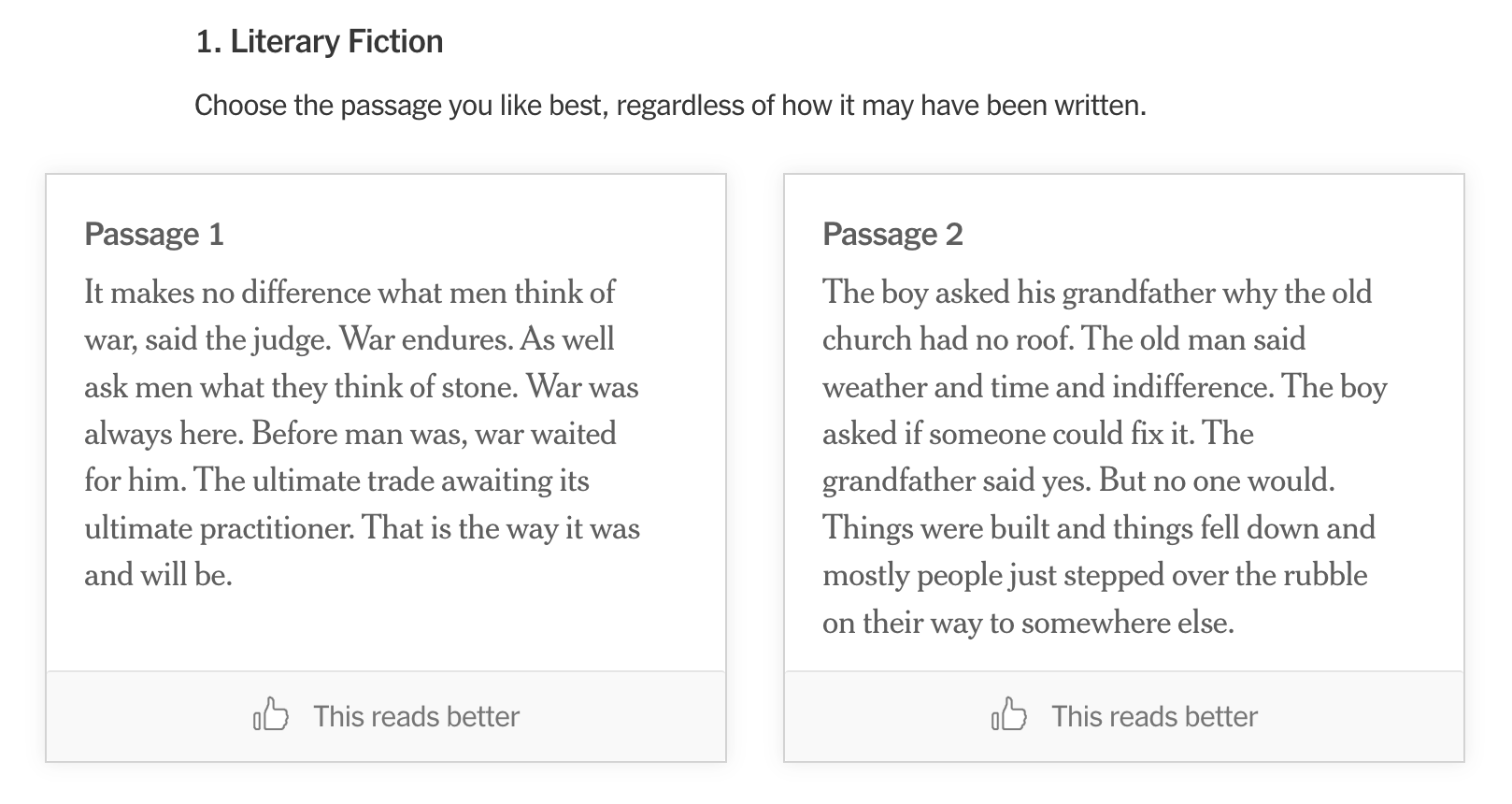
Gulp. No flipping to the back of the book for the answer to this particular puzzle. Click, and be either relieved or horrified. I gaped at the question feeling as though I were about to find out that Santa Claus isn’t real all over again—or, maybe, that I am not real after all. What was this sadistic exercise? It felt like something out of Squid Game: one false step, and the ground beneath your feet, everything you stand on and for, caves in. I didn’t want to play anymore.
But then I took a deep breath, and I did what I know how to do. I examined the language.
On the surface, both are written in simple enough language, in relatively short, declarative sentences. They both have a kind of detached, melancholic tone as they meditate on ineluctable facts of life: war, time. Each has some point of linguistic interest: Passage 1’s odd use of verbs (“As well ask men” and “Before man was”); Passage 2’s use of polysyndeton (repeated conjunctions like “and’s”). How, then, to identify the traitor in our midst?
Well, we would do well to remember that carefully arranged language is meant to produce an effect—to advance an argument, more importantly to evoke a feeling, to say something not only in what is said, but also in how it’s said.
Perhaps you learned about literary devices at some point in your life; you might not know that the word “device” is etymologically linked to the idea of “express[ing] or mak[ing] known one’s plan or will.” Literary devices are not there for shits and giggles; they are there to express or make known the artist’s plan or will. Each choice must, or at least should, be planned, willed—intentional.
The same goes for any other art form: the use of minor chords to create a sensation of sadness is but one tool in a composer’s chest; what happens when the notes are articulated legato as opposed to staccato, or what happens when the tempo is marked grave instead of presto? What if The Brutalist (yes, I’m beating that horse again) were not 3 hours and 35 minutes long, so long that it requires a 15-minute intermission? If it kept the same plot, would it be the same film? Would it stand as adequately for the massive, exposed, enduring brutalist buildings it sought to embody?
Obviously not; form follows function. The question to ask, then, is this: what is the form, what function does it serve, and does it serve it compellingly, in such a way that draws us into a kind of empathetic union with the artist? Do we feel how they feel, too?
So, Passage 1: what’s going on?
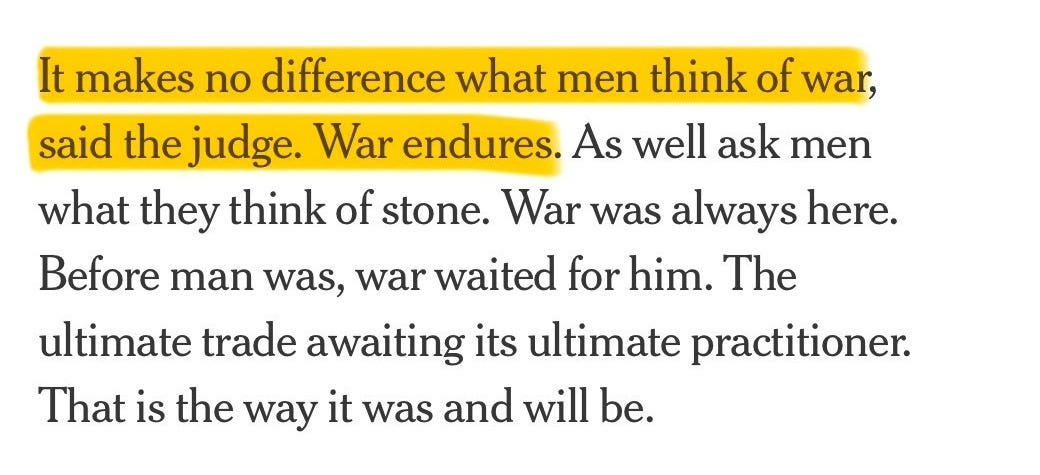
The first sentence, focused on what men think, has 12 words. The second sentence, focused on what war does, by contrast, has only 2. That’s an interesting juxtaposition.
But what makes it successful is that the contrast itself makes the point: “War endures” is about as stripped bare a sentence as it gets, landing in the passage almost like a punctuation mark, with a kind of irrefutable finality that, in its concision, in its denseness, allows no way in—and no way out. Men can think all they want; they can think themselves to death. And when they’re done with all of their thinking, war will have thought nothing of them—will have only endured.
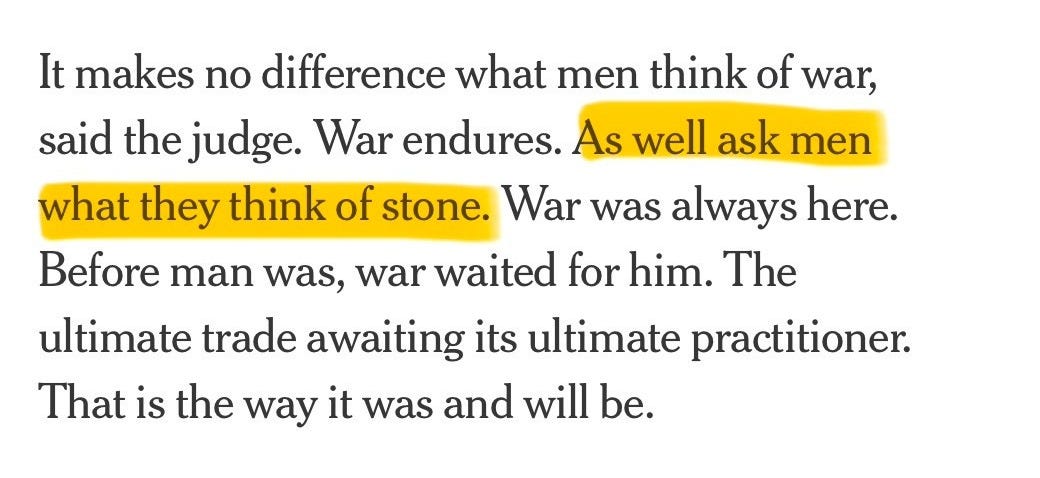
Next, we have a curious syntactical construction: “As well ask men what they think of stone.” The expanded, grammatically correct version of the sentence is: “[You might] as well ask men what they think of stone.” Why elide the subject (“you”) and modal auxiliary verb (“might”)? It’s difficult to know exactly, from a passage taken out of its context (here Cormac McCarthy’s critically acclaimed American novel Blood Meridian, to give away the answer). Who is this judge and why does he speak in this oracular way? Still, we wonder: maybe the omission of the subject and helper verb illustrates the futility of the exercise of asking men what they think of war. The judge, in not bothering to waste his breath on uttering the complete sentence, instructs us not to waste ours on asking men such inane questions.
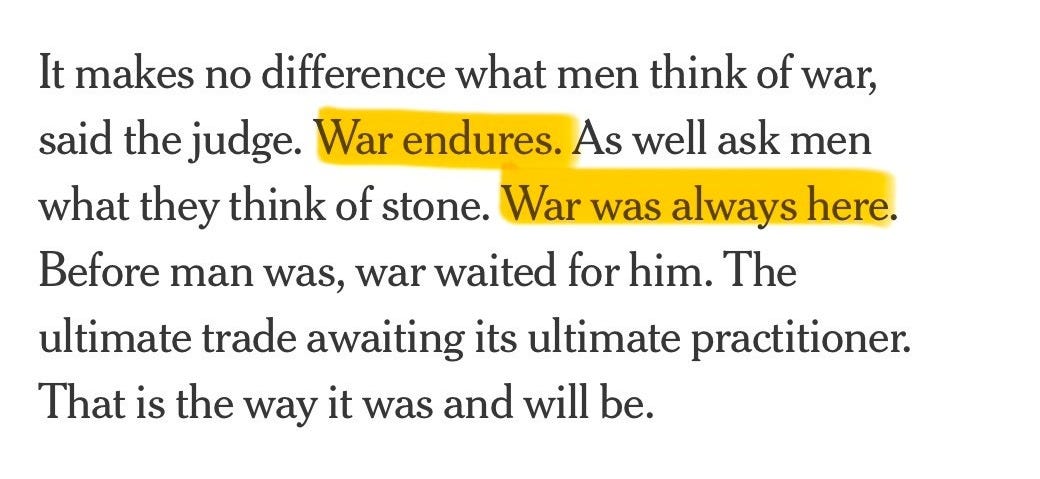
Then, another reminder, in another short, blunt sentence: “War was always here.” In case we didn’t get the point the first time, the sentence reinforces the earlier one, with a tense change: “War endures,” in the present tense, tells us what war does now; “War was always here,” in the past tense, tells us what war did before.
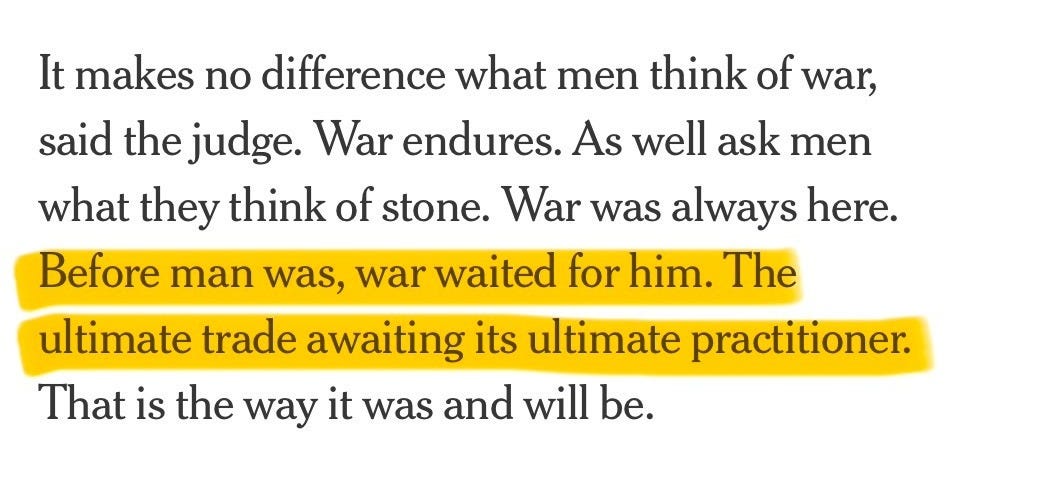
How long before, we might ask? The judge tells us—“Before man was, war waited for him”—before uttering another sentence fragment— “The ultimate trade awaiting its ultimate practitioner”—with another tense change, the present participle “awaiting” representing the continuous present. The fragment itself, in having no verb or action, presents war not as an event that happens, but rather as an immutable fact that is.
So the judge has established that war predates us (past), endures beyond us, and persists so long as we, the practitioners of it, exist (continuous present). Finally, he says: “That is the way it was and will be.”
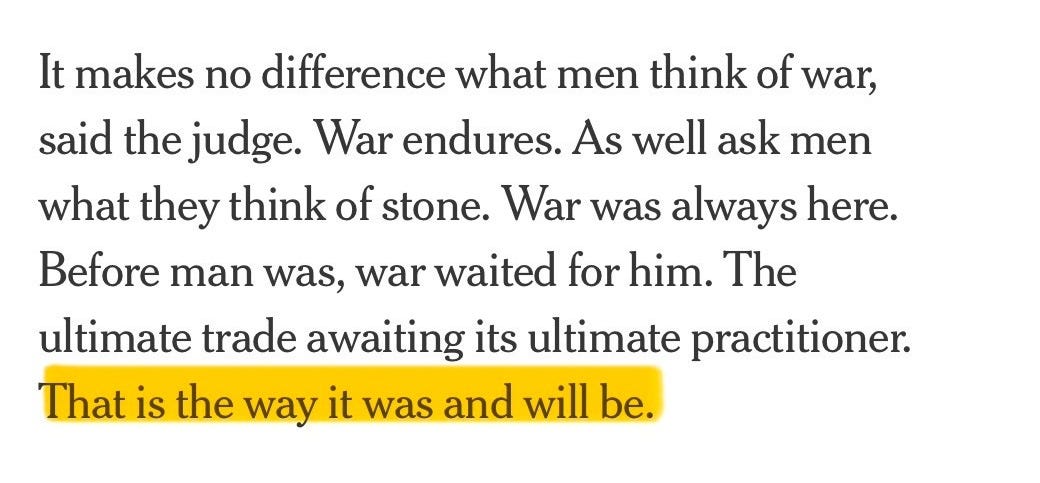
The future tense (“will be”) is the final nail in the coffin, constructed around us over the course of this passage: look back, up, down, around, and forward—there is no escaping war.
Meanwhile, Passage 2 makes me think—and, critically, feel—much less. If anything, it makes me want to rewrite it so that it has some structural integrity. Let’s go sentence by sentence again.
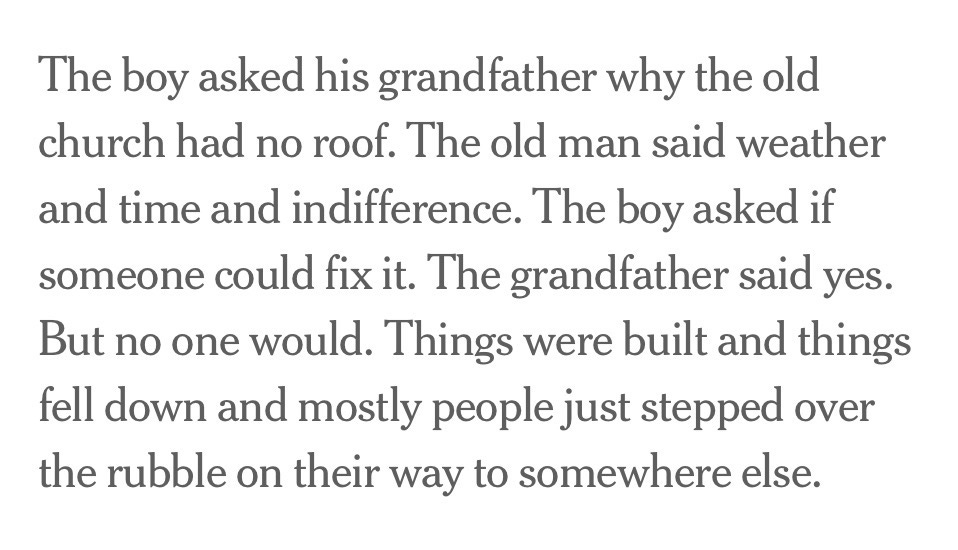
“The boy asked his grandfather why the old church had no roof.” Okay, we have a couple of characters, in dialogue, and an image. We’re in a dilapidated place.
“The old man said weather and time and indifference.” The critic in me immediately recoiled at this sentence, at the disjunction between syntax and sentiment. In reading this sentence—putting aside its grammar, for a moment—I imagine the old man resigned and contemplative, lamenting the church’s present condition and remembering, perhaps, a more vibrant past. When I wonder how he might express his thoughts, then, I imagine a slow, languorous pace.
Instead, Anthropic’s Claude, Opus 4.5, hits me with a polysyndeton…with no goddamn commas?? The effect is a rapid, relentless rhythm—“weather and time and indifference”—totally antithetical to the actual rhythm of weather, and time, and indifference: weather acts slowly, cumulatively—as does time, as does indifference. Function—ever met form? Clearly not in this sentence.
The presence of a literary device is not evidence of literariness.
As we’ve established, a literary device is just that—a device: it must serve some purpose. Here, it hangs like a dangling modifier, with no subject to which to attach it. This, dear reader, is the moment I knew that I was dealing with AI slop. But for the sake of the exercise, I’ll continue with the sentence-by-sentence breakdown.
“The boy asked if someone could fix it.” We get a sense of the boy’s orientation towards the world—he wants to see renewal.
“The grandfather said yes.” Yes, someone could fix it, but will anyone? Perhaps the grandfather wants to protect the boy’s innocence—let him believe in the possibility of that renewal.
“But no one would.” We get our question answered. There’s a little emotional payoff just in knowing the fact that no one is coming to tend to this neglected place, but so far it’s not very linguistically interesting.
“Things were built and things fell down and mostly people just stepped over the rubble on their way to somewhere else.” Another polysyndeton, with some grammatical variation, it seems, again, for its own sake. The proper version of this sentence would read, “Things were built, and things fell down, and mostly people just stepped over the rubble on their way to somewhere else,” and it seems to work just as well. So why skip the commas again? Here, the fast pace is less offensive to me: the sentence, in a way, is describing how quick people are to treat this place as a stepping stone. But I’m only half-convinced. This polysyndeton is our second in a very short passage, and it’s not doing nearly enough work to warrant its repeated use. Pass.
For the sake of space, I’m going to skip to the last question in the quiz—yes, the Elizabeth Bishop question:
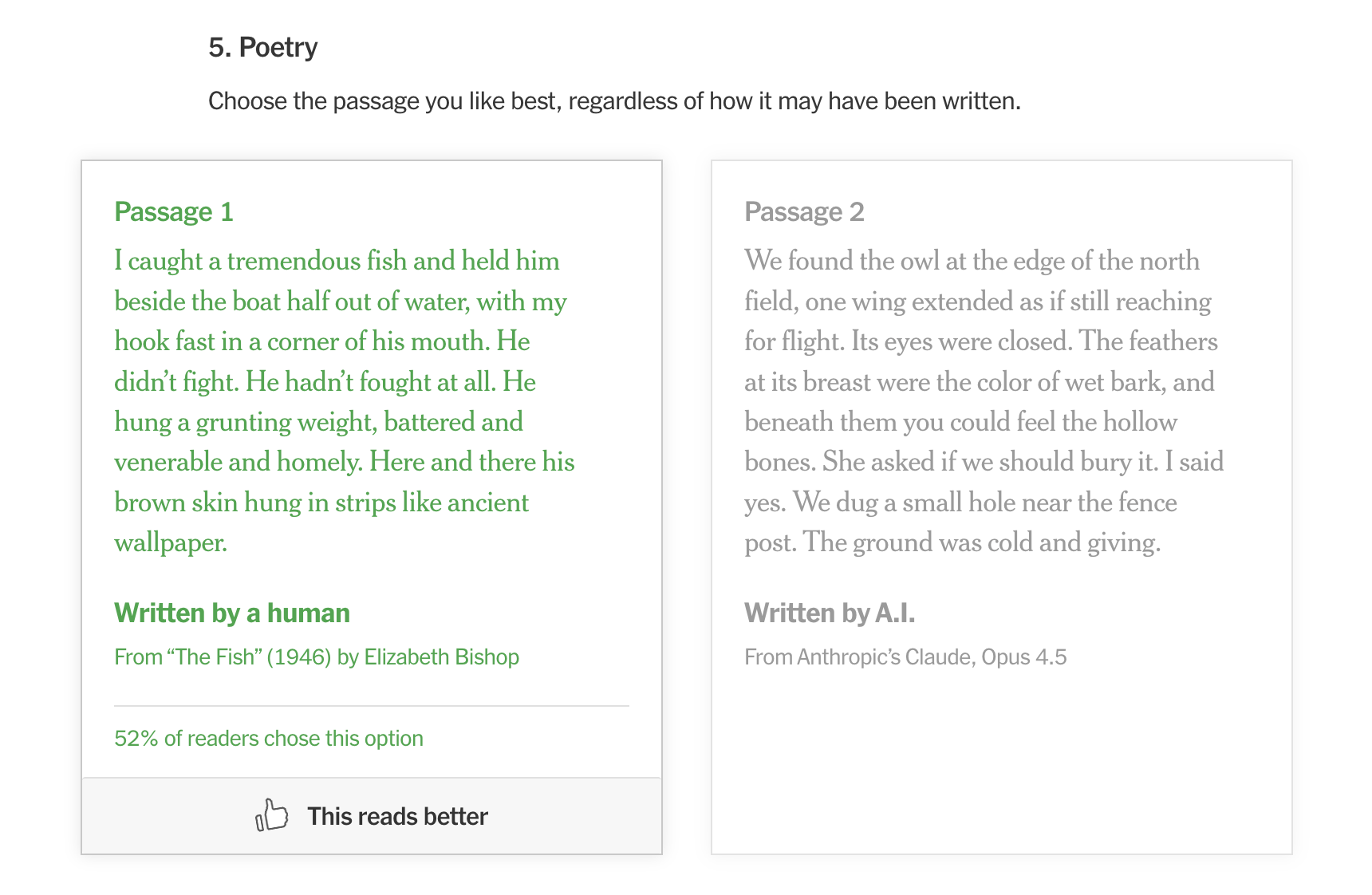
First thing’s first, let’s undo the poem’s bastardization by The New York Times’s inexplicable refusal to format it properly and read the poem as it was meant to be read, line breaks and all:
I caught a tremendous fish
and held him beside the boat
half out of water, with my hook
fast in a corner of his mouth.
He didn’t fight.
He hadn’t fought at all.
He hung a grunting weight,
battered and venerable
and homely. Here and there
his brown skin hung in strips
like ancient wallpaper
What immediately arrests us about this opening? Well, for one, it subverts a traditional narrative arc. Usually, the climax of a fishing trip is…catching a fish! But Bishop begins “The Fish” at this climactic point, and in doing so she neutralizes its charge. Catching the fish is not the point of this trip; it is merely the beginning.
What more? We might imagine the moment Bishop catches this fish—the fish’s desperate flapping, her wrestling with it with her hands, the final blow to the head—but we would be wrong: he doesn’t fight, and she just holds him (suddenly it’s a “him”) there, at each turn observing something new about the fish—his surprising surrender (“He didn’t fight”), his shape (“He hung a grunting weight”), the shape he’s in (“battered and venerable / and homely”). Capturing the fish, then, presents the opportunity to “capture” the fish in another way: visually, with the rods in her eyes instead of her fishing rod.
Notice we have a polysyndeton…again without commas!...in “battered and venerable / and homely.” Oh, but here its use is masterful. Battered and venerable stands as its own phrase and line, making us think of a war veteran, until the enjambment (where a sentence continues from one line to the next without punctuation) introduces a second thought, a kind of doubling back: “and homely.” The fish is not sublimely beautiful, as many objects of veneration are; rather, he is “homely.”
And the crypt word behind “homely,” of course, is “home.” Indeed as soon as Bishop writes the word “homely,” she begins to describe the fish as though he were a home, with “brown skin… / like ancient wallpaper.” In just 11 lines, Bishop’s subject transforms from fish to gendered “him” to war hero to person with “skin” (as opposed to scales) to battered and venerable home, its wallpaper peeling.
Contrast that transformation with the lack thereof in Claude’s “poem” about another creature, an owl:
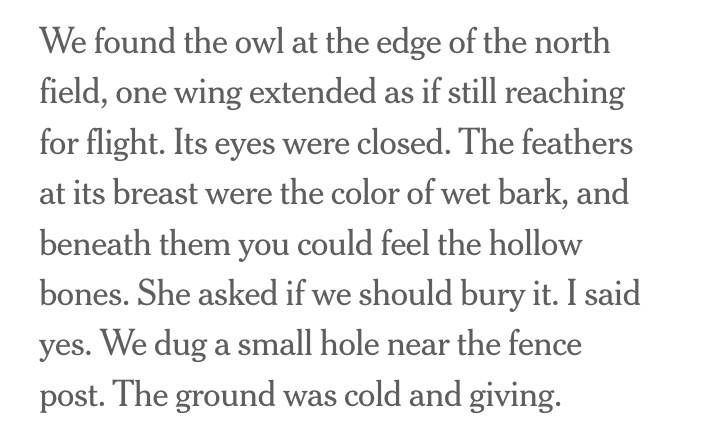
Here’s a summary of what happens—or, more aptly, what doesn’t happen:
They found a dead owl, that looked like a dead owl, that they buried, because it was dead.
Sure, there are nice turns of phrase, if plainly stolen from those of other poets: Claude’s “one wing extended,” for example, immediately calls to mind the closing phrase of Wallace Stevens’ “Sunday Morning,” “on extended wings.” And reasonable people who love words and writing (case in point: Artificial Whimsy’s better half) can fall for AI’s magic trick:
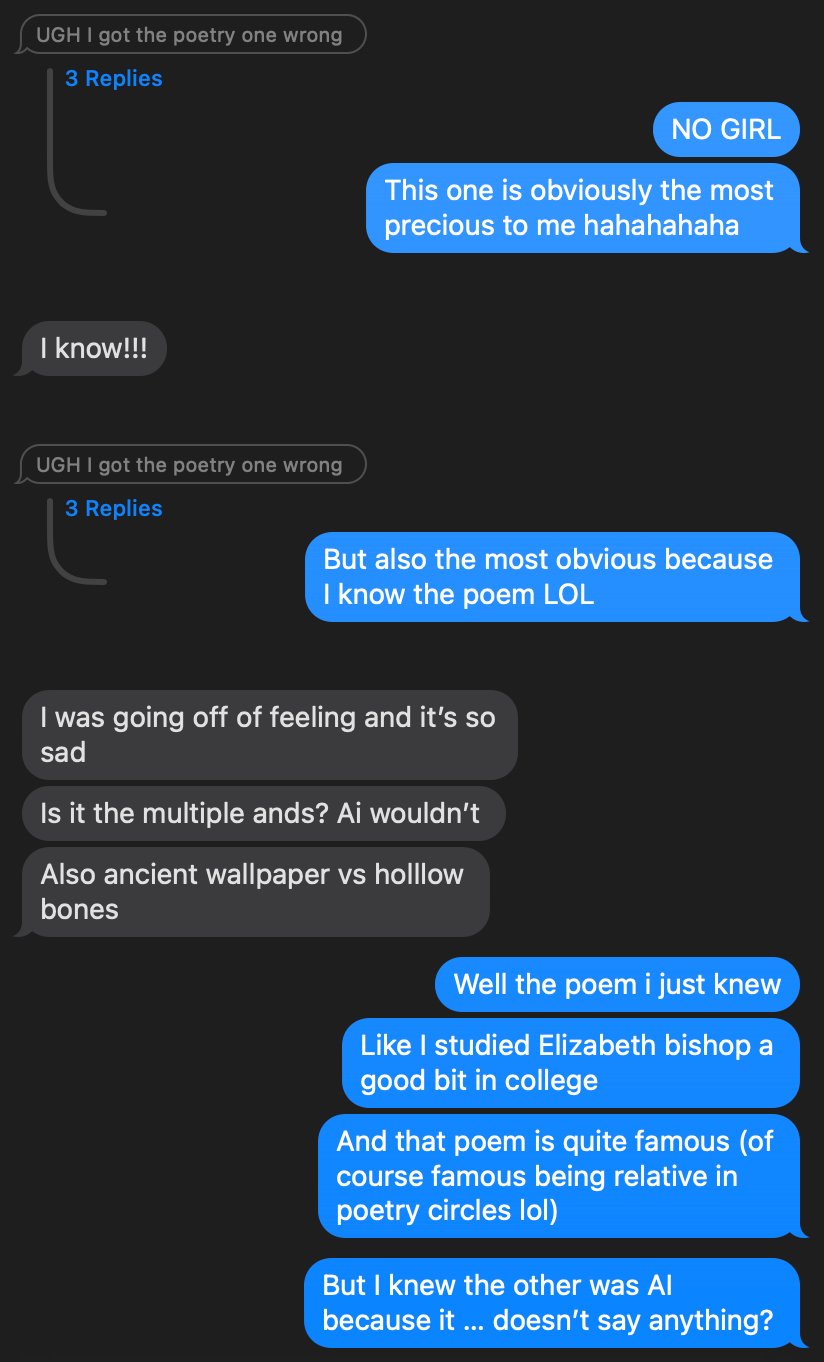
But, as I explained to Danielle over text, it’s not the multiple ands (we saw AI do that unconvincingly earlier)—it’s that the “poem,” as a whole…doesn’t say anything. I’m not surprised by anything; nothing changes.
There is a term, in poetry, called a volta; it’s Italian for “turn.” These turns are much of what propels poems forward. Poems are often a reflection of a poet’s thinking process about something—tracking how they thought about it at first, how they reconsidered it, what they realized in the end. Not all poems must have one; still, every poem must have a direction, either in having one or not, and I cannot discern any such direction in Claude’s owl “poem,” flat as the screen on which it flashes.
As Wordsworth wrote, “I trust…that my descriptions of such objects as strongly excite those feelings, will be found to carry along with them a purpose. If this opinion be erroneous, I can have little right to the name of a Poet.” Claude, by this definition, can have little right to the name of a Poet.
Ah, but who cares, right? We’re all cooked, etc.
I don’t think so. I was recently thumbing back through George Saunders’ A Swim in a Pond in the Rain (a book version of his creative writing course at Syracuse and a wonderful technical entry into how Russian short stories, and stories generally, work), and was struck by his meditation on the epistemic, existential importance of close reading—a strength that can be developed, like anything else—which I couldn’t articulate better myself:
To study the way we read is to study the way the mind works: the way it evaluates a statement for truth, the way it behaves in relation to another mind (i.e., the writer’s) across space and time….Why would we want to do this? Well, the part of the mind that reads a story is also the part that reads the world; it can deceive us, but it can also be trained to accuracy; it can fall into disuse and make us more susceptible to lazy, violent, materialistic forces, but it can also be urged back to life, transforming us into more active, curious, alert readers of reality.
I would add only that to study the way we read is also to study the way the heart works: the way it attunes and responds to another human’s feelings.
We live in a world littered with misinformation, disinformation, and AI writing and deepfakes, where it is increasingly difficult to discern the truth, and where mind-bogglingly large and powerful entities have a vested interest in your believing certain truths (and not believing others). We also live in a world in which we are constantly bombarded with news so unfathomably horrible that we are compelled by instincts of survival to numb ourselves against the grief that would surely crush us if we allowed ourselves to feel it.
In such a world, I posit that it is more important than ever to read it more closely. Learning to close-read—to ask, of any piece of information, in how it is written or presented, “Why?”—is at once a defense of our epistemic agency (our capacity to think) as well as of our emotional sensitivity (our capacity to feel). It is a defense, in other words, of our humanity.
And it is still possible. First of all, AI gives itself away: a 2025 study by Jenna Russell (University of Maryland, College Park), Marzena Karpinska (Microsoft), and Mohit Iyyer (University of Maryland, UMass Amherst) found that people “who frequently use LLMs for writing tasks excel at detecting AI-generated text, even without any specialized training or feedback,” and even outperforming automated AI detectors. Reading is training. Spend enough time on LinkedIn, and you’ll get really good at detecting AI-generated writing. By the same token, read enough great literature, and I bet you’ll get really good at detecting that, too. (And which would you rather do, really?)
But these shortcuts—looking for giveaways of AI writing—are unsatisfying and inevitably ephemeral as the technology continues to improve and change. At the end of The New York Times quiz, my results read:
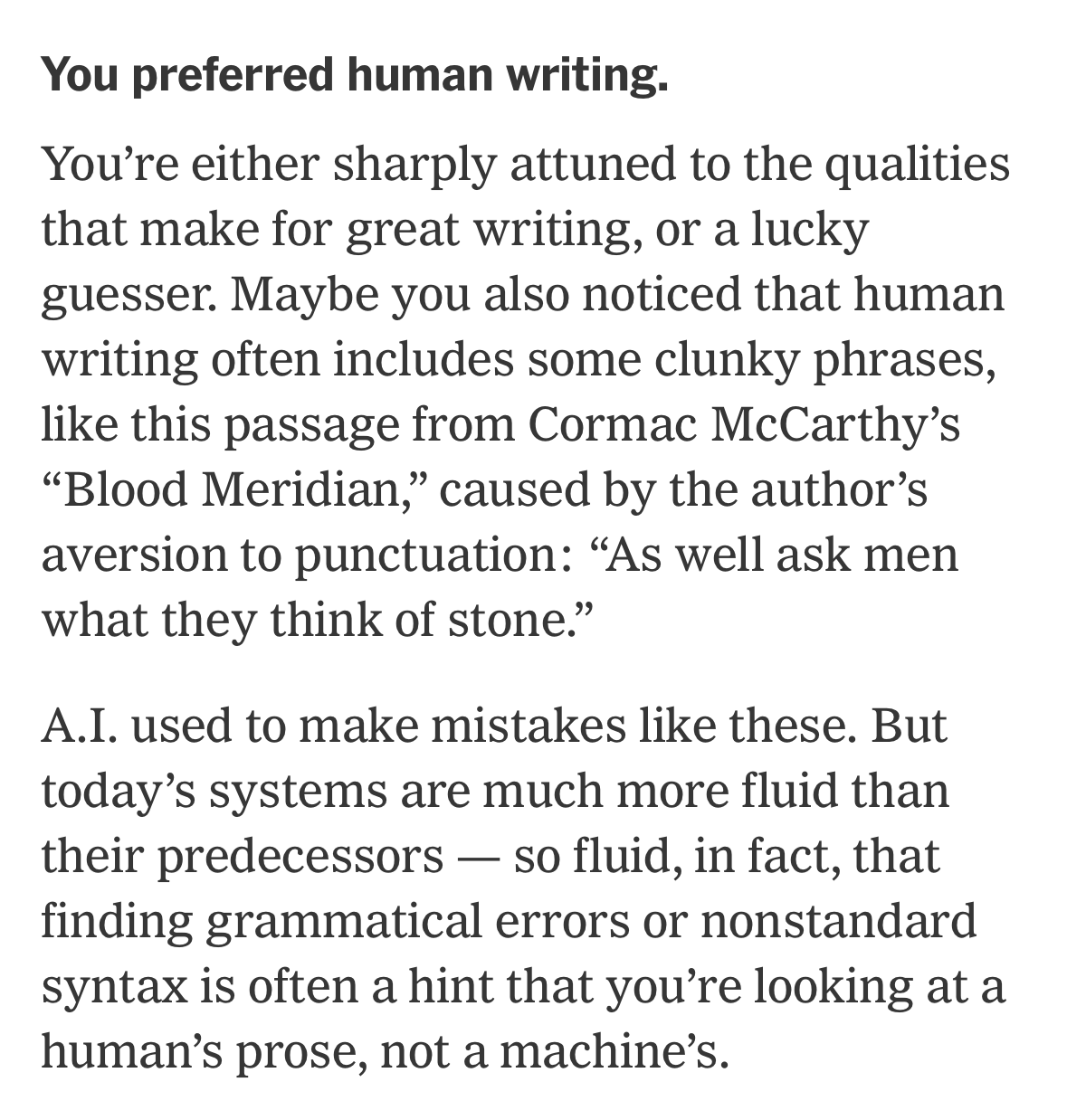
“Clunky”?
“Mistakes”?
I wanted to throw my phone across the room. How sad—how clichéd—to say that imperfection is the mark of human writing (though we do get a kick out of our classmate’s partner’s viral “anti-Grammarly” AI tool, Sinceerly, that cheekily adds typos to your emails to make them more human). It’s a good bit, but it doesn’t give human writers enough credit for conscious imperfection.
Indeed, it is this consciousness—not em-dashes, or antitheses, or sanitized syntax—that distinguishes human writing from AI writing, and by extension humans from AI. The precondition for the use of a literary device is an author’s conscious intent, borne out of the desire to convey and evoke some human feeling: so look for the purpose—ask “Why?”—and let that purposefulness (or the apparent lack thereof) be your Turing test. Though we anthropomorphize AI and can even, sometimes, mistake its voice for a human’s, it will never be conscious in the way that humans are conscious: anything it knows of life is inherently derivative of how humans have represented it—and any meaning it has, it has because we give it meaning. Even the most detailed, accurate, and precise map—the original “world model,” as many neural network AI companies are calling themselves—will never leap off the page and become the world.
AI has only symbols; we have life itself. As William Carlos Williams wrote, “No ideas / but in things.” We make meaning out of our experiences and feelings. It’s as simple as that, and AI won’t ever be able to do it.
weekly whimsy
What we’re listening to:
Céline: “On Edge” by Antonio Barret (local to where I’m moving to post-GSB…there’s a clue for you)
Danielle: Midnight Generation (thank you Matheus S. for the rec!)
What we’re using:
Danielle: Rejuran Salmon Sperm Turnover Ampoule (yes, you heard me)
Céline: NuttZo 7 Nut and Seed Butter (this is, not on purpose, a very…testicular section)
What we’re watching/reading:
Céline: Funny AF with Kevin Hart on Netflix (close reading, but make it stand-up comedy! A fun, not-overly-produced performance/competition show, where some of the most successful comics break down, sometimes pretty technically, what makes a set work or not)
Danielle: A Short Stay in Hell by Steven L. Peck
Written by: Céline Vendler
Edited by: Danielle Zhang
The NYT quiz's ending note is not only insulting but stupid. Absolutely braindead. Referring to McCarthy's "As well ask men what they think of stone" as evidence of an "aversion to punctuation"??!! I guess someone at NYT thinks that the same meaning would be conveyed by "As well, ask men what they think of stone", even though the latter would be grammatically nonsensical and convey nothing close to the same meaning.
I like to write, so for me, using AI would defeat the entire purpose.
I’m also intensely turned off by finding out some writing is AI-assisted. Like in chess, we want to see the human voice. Nobody wants to watch bots play, even if they can outplay all humans.